Key takeaways
- Five camp stoves for tent trips and outdoor meals, from ultralight canister burners to a two-burner camp kitchen, with fuel, output and pack size compared.
A tent trip lives or dies by the camp kitchen. The right stove boils water before the morning chill sets in and packs down small enough that it never becomes the thing you regret carrying.
This guide covers five stoves for different tent trips: a featherweight canister burner, an integrated fast-boil system, a dual-fuel single burner, a two-burner camp kitchen, and a wind-resistant regulated burner. The best pick depends on how you camp, how many people you feed, and how much weight you carry.
One safety rule comes first: never light a fuel stove inside a tent, a vestibule, or any enclosed space. Fuel stoves produce carbon monoxide and present a serious fire hazard indoors. Cook outside, in open air. These stoves are for tent trips, not for use inside the tent.
As an Amazon Associate, we earn from qualifying purchases.
Quick Answer
For tent campers, the Camp Chef Everest 2X is the capable camp kitchen, with two burners for group meals. Solo hikers should look at the MSR PocketRocket 2 for its tiny packed size, while the Jetboil Flash wins on boil speed for freeze-dried meals and coffee. The Gas One GS-3400P covers dual-fuel flexibility on a budget, and the SOTO WindMaster holds its flame best in wind and cold.
How to Choose a Camping Stove for Tents and Outdoor Meals
Fuel type shapes everything else. Canister stoves run on threaded isobutane-propane canisters that are light and clean, but the canister costs extra and empties must be carried out. Propane stoves use the common green 16.4 oz cylinders, which suit car camping. Dual-fuel stoves accept both butane and propane, which helps when one fuel type is sold out.
Output decides what you can cook. A burner around 8,000 to 11,000 BTU handles boiling and one-pot meals for one or two people. Two burners at 20,000 BTU each turn a campsite into a real kitchen, though high output burns fuel faster.
Weight matters most in a backpack. A canister-top burner can weigh under 3 ounces and fold into a cook pot. An integrated system weighs around 13 ounces but replaces burner, pot, lid, and windscreen in one package. A two-burner propane stove weighs around 12 pounds and belongs in a car.
Wind performance separates good stoves from frustrating ones. A recessed burner head, a pressure regulator, and a windscreen help a flame hold steady in gusts. Open burners lose heat fast in wind, so pick a sheltered cooking spot.
Push-button piezo ignition lights the stove without a lighter, but piezo igniters can wear out, so always pack matches or a lighter as backup. Manual-ignition stoves demand a lighter from the first use.
A three-arm support suits small pots and mugs, while a four-arm support steadies wider pots and small frying pans. Check the maximum cookware size the maker lists before pairing a heavy pan with a tiny burner.
1. MSR PocketRocket 2

The PocketRocket 2 is the classic ultralight canister stove: a folding burner that screws onto a threaded fuel canister and disappears into a cook pot when packed. At a minimum weight of 2.6 ounces, it is the lightest stove in this guide by a wide margin, and it suits solo hikers and pairs who boil water for freeze-dried meals and coffee.
MSR lists a boil time of 3.5 minutes for one liter of water using its IsoPro fuel, with about 60 minutes of burn time per 8-ounce canister. The three-arm pot support handles pots up to 8 inches across, and the WindClip windshield helps in light wind. A hard-shell carry case is included.
There is no built-in igniter, so a lighter or matches are required, and the small burner head is exposed to wind. The canister is not included. For boil-and-eat trips where every ounce counts, those limits are easy to accept.
Confirm the listing and stock before ordering: an older crawl showed no featured offers, so check that the listing is live at publish time.
Specs
- Fuel: Isobutane-propane threaded canister, not included
- Output: 13,200 BTU per hour
- Minimum weight: 2.6 ounces
- Boil time: 1 liter in 3.5 minutes, maker figure
- Ignition: Manual, lighter or matches required
- Pot support: Three-arm, up to 8-inch cookware
- Model: 09884
- ASIN: B01N5O7551
2. Jetboil Flash

The Jetboil Flash is an integrated cooking system, not a bare burner. The burner, 1.0-liter FluxRing cooking cup, insulating cozy, lid, and fuel canister stabilizer arrive as one nested unit, and the heat-exchanger ring captures heat that open burners waste. Half a liter of water reaches a rolling boil in about two minutes.
Push-button ignition lights the burner with a turn of the knob, and a color-change heat indicator shows when the cup is hot. The system weighs 13.1 ounces and packs to about 4.3 by 7.3 inches, with a 100-gram canister nesting inside the cup. It suits one or two people.
The Flash has almost no simmer control, so sauces and foods that need a low flame belong on a different stove. Fuel canisters are sold separately. Jetboil refreshed this model for 2025, so confirm the listing shows Carbon and model 1097714 before buying.
Specs
- Fuel: Isobutane-propane canister, not included
- Output: 5,300 BTU per hour
- System weight: 13.1 ounces
- Capacity: 1.0-liter FluxRing cooking cup
- Boil time: 0.5 liter in about 2 minutes, maker figure
- Ignition: Push-button auto ignition
- Model: 1097714, Carbon
- ASIN: B0753NBMJ5
3. Gas One GS-3400P
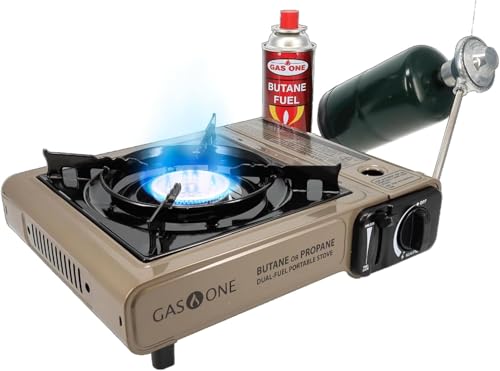
The Gas One GS-3400P is the dual-fuel single burner in this guide, and its appeal is flexibility. It runs on a single 8-ounce butane cartridge or a 16.4-ounce propane cylinder, with the propane converter regulator included, so you can burn whichever fuel is on the shelf. A carrying case is included, and the stove measures 13.5 by 11 by 4.45 inches at 3.1 pounds.
A piezo igniter lights the flame without a lighter, and a pressure sensor ejects the cartridge if pressure rises beyond safe limits. The 8,000 BTU output suits simmering, coffee, and small-batch cooking, with an adjustable dial for flame control.
At 8,000 BTU, it is one of the slowest stoves here for boiling a full liter, and butane loses strength as temperatures drop toward freezing. It is a single burner, so only one pot cooks at a time. Do not confuse this stove-only listing with the bundle that adds four butane canisters under a different code.
Specs
- Fuel: Butane 8-ounce cartridge or propane 16.4-ounce cylinder, not included
- Output: 8,000 BTU per hour
- Weight: 3.1 pounds
- Ignition: Automatic piezo ignition
- Safety: Pressure sensor cartridge ejection
- Included: Carrying case, propane converter regulator
- Model: GS-3400P
- ASIN: B01HQRD8EO
4. Camp Chef Everest 2X

The Camp Chef Everest 2X is the camp kitchen in this guide. Two burners at 20,000 BTU each give 40,000 BTU in total, which boils a liter of water in just over two minutes and handles large pans and full family meals. A three-sided windscreen shields the flame.
Push-button matchless ignition lights each burner, and the burners hold a genuine simmer as well as full power. The stove weighs about 12 pounds and folds for storage, which suits car camping and group trips where the stove rides in a vehicle.
It is too heavy for backpacking, and its high output burns fuel faster, so carry a spare cylinder on long trips. The piezo igniter can fail after extended use, so pack a lighter as backup. Confirm the listing shows model MSHPX.
Specs
- Fuel: Propane cylinder, not included
- Output: 40,000 BTU per hour total, 20,000 per burner
- Weight: About 12 pounds
- Burners: 2, independently adjustable
- Ignition: Push-button matchless ignition
- Wind protection: Three-sided windscreen
- Model: MSHPX
- ASIN: B09KNVRDNQ
5. SOTO WindMaster
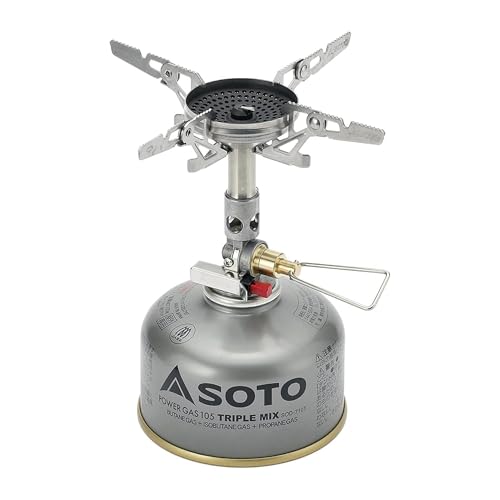
The SOTO WindMaster is the weather pick in this guide. Its concave burner head sits the pot close to the flame inside a sheltered bowl, and a micro regulator holds output steady as the canister cools and empties. SOTO lists 11,000 BTU, and the stove keeps boiling in wind and cold where unregulated burners fade.
The 4Flex pot support arrives in the box and holds wider cookware steady on four arms; the stove weighs 87 grams with it fitted. The burner alone weighs 67 grams with the narrower TriFlex support, sold separately. A stealth piezo igniter lights the stove without a lighter.
The WindMaster is a burner only, so you supply your own pot, and it suits one or two people rather than group cooking. Like other piezo igniters, the built-in igniter can wear out, so carry matches or a lighter. Confirm the listing shows model OD-1RXN with the 4Flex support included.
Specs
- Fuel: Isobutane-propane canister, not included
- Output: 11,000 BTU per hour
- Weight: 87 grams with 4Flex support
- Ignition: Stealth piezo igniter
- Regulator: Micro regulator for steady output in cold and wind
- Pot support: 4Flex included, TriFlex sold separately
- Model: OD-1RXN
- ASIN: B07R7BZCB3
Who Should Skip
Skip the ultralight canister burners if you cook for a family or need two pots at once; the Everest 2X is the only stove here built for that job. Skip the Jetboil Flash if your menu needs real simmering, frying, or large pots. Skip the Gas One GS-3400P for cold-weather trips on butane. Skip the Everest 2X if the stove must fit in a backpack. And skip every stove here if the plan is to cook inside a tent: no fuel stove is safe in an enclosed space.
FAQ
Can I use a camping stove inside a tent?
No. Never light a fuel stove inside a tent, vestibule, vehicle, or any enclosed space. Fuel stoves produce carbon monoxide and present a serious fire hazard indoors. Always cook outside in open air, with the tent clear of the flame.
Which fuel should I bring for a tent trip?
Threaded isobutane-propane canisters suit backpacking because they are light and clean. Green 16.4-ounce propane cylinders suit car camping. Dual-fuel stoves accept either butane or propane, which helps when one fuel type is sold out.
How much fuel do I need for a weekend?
It depends on the stove and the menu. A small canister stove can run about 60 minutes on an 8-ounce canister, while a two-burner stove at full output burns through a 16.4-ounce cylinder in about an hour. Boiling water for freeze-dried meals uses far less fuel than cooking full dinners, so carry a spare on longer trips.
Do I still need a lighter if the stove has push-button ignition?
Yes. Piezo igniters can wear out or fail in wet and cold conditions, and one stove here has no igniter at all. Pack matches or a lighter on every trip, and keep them dry.
Final Verdict
The best camping stove for a tent trip matches how you travel and what you cook. The Camp Chef Everest 2X is the strongest choice for car camping and group meals. The MSR PocketRocket 2 is the pick for solo hikers who count every ounce. The Jetboil Flash is the fastest way to hot water. The Gas One GS-3400P is the flexible budget burner for fair-weather trips. The SOTO WindMaster is the stove to trust in wind and cold. Choose by fuel, weight, and menu, confirm the exact model before ordering, and cook outside the tent every time.