Key takeaways
- Compare the best bike computers for rides and training data in 2026. Five GPS head units with maps, power metrics, and long battery life for road.
Best Bike Computers for Rides and Training Data 2026
A handlebar-mounted GPS bike computer turns a ride into data you can actually use: speed, distance, climbing, power, heart rate, and a route that keeps you on course without a phone rattling in your pocket. The right unit depends on how you ride. A commuter, a racer, and a weekend gravel rider need different devices. This guide covers five handlebar computers for those jobs, from a value pick with offline maps to a flagship with a large touchscreen. Every pick below is a dedicated cycling head unit, not a wrist watch and not a phone mount, and each one pairs with common speed, cadence, heart rate, and power sensors.
As an Amazon Associate, we earn from qualifying purchases.
Quick Answer
For most riders, the Garmin Edge 540 is the sweet spot: full maps, adaptive coaching, and long battery life in a compact button-controlled unit. A touchscreen points to the Edge 840, while the Wahoo ELEMNT BOLT V3 suits riders who prefer simple buttons and fast setup. The Edge 1050 is the flagship for big-screen navigation, and the iGPSPORT iGS630 is the value pick for maps on a budget.
How to Choose a Bike Computer
Look at the screen first. Touchscreens make panning maps and tapping through menus quick, but they can be awkward with thick gloves or in heavy rain. Button-only units stay reliable in bad weather and with gloves, and many riders prefer them for that reason. Screen size matters too: a 2.3-inch display is easy to read for a few data fields, while a 3.5-inch display shows maps and a dozen fields at once.
Next, check navigation. A computer with preloaded maps and turn-by-turn prompts reroutes you when you miss a turn, while a basic unit only shows a breadcrumb trail that you must follow without prompts. If you ride new routes often, full maps are worth paying for. On familiar loops, a simpler unit saves money.
Battery life is the third decision. Real rides run shorter than the quoted maximum, especially with navigation active and sensors connected. A unit rated for 20 hours covers most single-day rides, while a unit rated for 35 hours or more suits multi-day trips and ultra-distance events. USB-C charging matches the cable most riders already carry.
Sensor support comes fourth. Nearly every GPS computer pairs with Bluetooth and ANT+ heart rate straps, speed and cadence sensors, and power meters. If you train with power, confirm the unit shows power zones, normalized power, and structured workouts from your training app. Radar compatibility is a bonus for road riders.
Finally, think about the ecosystem. Garmin, Wahoo, Bryton, and iGPSPORT each have their own companion app for setup, route sync, and ride uploads to Strava and Komoot. A unit that syncs with the apps you already use keeps your ride history in one place.
1. Garmin Edge 540

The Edge 540 is the compact all-rounder in this guide, and it is the pick most riders should buy first. It uses buttons only, so it works with gloves and in rain, and its 2.6-inch color display is large enough for maps and six data fields at a glance. Multi-band GNSS keeps the track accurate under tree cover and between tall buildings, and the unit pairs with power meters, heart rate straps, speed and cadence sensors, and Garmin Varia radar.
Training is where the 540 earns its place. It offers targeted adaptive coaching, stamina tracking, ClimbPro ascent planning, and Power Guide pacing when used with a compatible power meter and heart rate monitor. Routes sync from Garmin Connect, Strava, and Komoot, with turn-by-turn prompts and rerouting. Battery life runs up to 26 hours in demanding use, with a battery saver mode for longer days.
Specs: 2.6-inch color display; button controls; multi-band GNSS; 16 GB storage; up to 26 hours battery in demanding use; USB-C charging; ANT+ and Bluetooth sensor support; ClimbPro, Power Guide, and stamina tracking; works with Garmin Varia radar. ASIN: B0BT36VBGM.
2. Garmin Edge 840
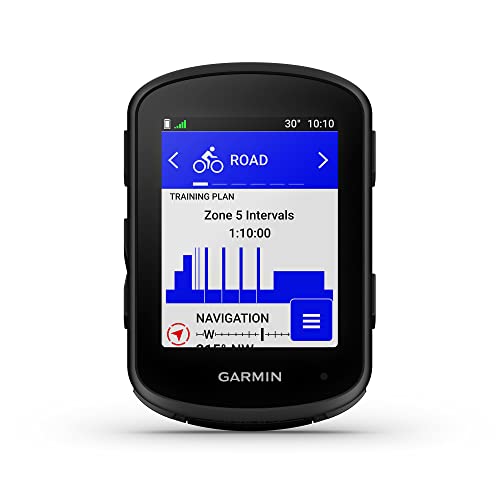
The Edge 840 takes the same core as the 540 and adds a touchscreen, which makes it the better pick for riders who pan maps often or tap through menus mid-ride. The 2.6-inch color display responds to touch and still has physical buttons, so you can use either control method depending on the weather and your gloves. It keeps the same multi-band GNSS, the same adaptive coaching, and the same sensor support, including power meters, heart rate straps, and Varia radar.
The extra storage is a practical difference: 32 GB holds more maps and routes than the 540, which matters on multi-day trips through new regions. Battery life matches the 540 at up to 26 hours in demanding use, with a battery saver mode for longer days. For map-heavy riding, the touchscreen justifies the extra cost over the 540.
Specs: 2.6-inch color touchscreen with buttons; multi-band GNSS; 32 GB storage; up to 26 hours battery in demanding use; USB-C charging; ANT+ and Bluetooth sensor support; ClimbPro, Power Guide, and stamina tracking; works with Garmin Varia radar. ASIN: B0BT36CRCQ.
3. Wahoo ELEMNT BOLT V3

The BOLT V3 is the current Wahoo compact computer, released in May 2025 as the replacement for the discontinued BOLT V2, and it is the simplest unit to live with in this guide. Setup runs through the Wahoo companion app on your phone, so the device itself stays free of deep menus. It uses five physical buttons and no touchscreen, with a 2.3-inch color display that stays readable in bright sun. Dual-band GNSS gives accurate tracking, and the unit pairs with power meters, heart rate straps, and speed and cadence sensors over ANT+ and Bluetooth.
Battery life is rated up to 20 hours, and one independent long-term test measured over 26 hours in real riding, so most riders will finish long weekend rides with charge to spare. Summit Segments show climb data, and structured workouts sync from training apps. At about 84 grams it is the lightest unit here, which matters on a race bike. The BOLT V3 uses the Wahoo mount, not a Garmin mount, and the two are not interchangeable.
Specs: 2.3-inch color display, 240 by 360 resolution; button controls only; dual-band GNSS; 32 GB storage; up to 20 hours battery claimed; USB-C charging; about 84 grams; ANT+ and Bluetooth sensor support; Summit Segments and structured workouts. ASIN: B0F4KR66TB.
4. Garmin Edge 1050

The Edge 1050 is the flagship in this guide, built for riders who want the biggest screen and the most connected ride. Its 3.5-inch color touchscreen is the largest here, and it shows maps, data fields, and group ride positions in detail that smaller screens cannot match. A built-in speaker gives audible prompts and a bike bell, Garmin Pay handles contactless payments at a cafe stop, and GroupRide keeps track of friends on the same route, with road hazard alerts and in-ride messaging through the Garmin Connect app.
Battery life runs up to 20 hours in demanding use and up to 60 hours in battery saver mode, and the 64 GB of storage holds maps for large regions. It pairs with power meters, heart rate straps, speed and cadence sensors, and Varia radar. One older crawl left a discontinuation flag unclear, so confirm the listing is live and sold as new, and confirm model number 010-02890-00.
Specs: 3.5-inch color touchscreen; built-in speaker and bike bell; Garmin Pay; 64 GB storage; up to 20 hours battery in demanding use, up to 60 hours in battery saver mode; USB-C charging; ANT+ and Bluetooth sensor support; GroupRide, road hazard alerts, and in-ride messaging. ASIN: B0D6SBYCVH.
5. iGPSPORT iGS630

The iGS630 is the value pick in this guide, and it is the right choice for riders who want full maps and long battery life without paying for a premium brand. Its 2.8-inch color display shows offline maps with turn prompts, and the iClimb function gives a graphical preview of climbs with distance and elevation gain. Five satellite systems give fast locks, and the unit pairs with speed, cadence, heart rate, and power sensors over ANT+ and Bluetooth, with ride uploads to Strava and Komoot through the iGPSPORT app.
Battery life is rated at about 35 hours, the longest claim in this guide, which suits multi-day rides and ultra-distance events. The unit carries an IPX7 water resistance, so rain is not a concern. Confirm the listing before ordering, since a sensor bundle version of the same model also exists.
Specs: 2.8-inch color display; offline maps with turn prompts; iClimb climb preview; five-satellite GNSS; about 35 hours battery claimed; IPX7 water resistance; USB-C charging; ANT+ and Bluetooth sensor support; Strava and Komoot sync through the iGPSPORT app. ASIN: B09XX5FVHJ.
Who Should Skip
Skip a dedicated bike computer if you only ride short, familiar routes and only want speed and distance, since a basic wireless computer or a phone app covers that job for less money. Skip the flagship models if you never follow a route, since maps and group ride features are the main reason to pay more. Riders who prefer a wrist device should buy a GPS watch instead, since a handlebar computer is a different product that mounts on the bike, not on your arm. Indoor trainer riders gain little from a computer, since the trainer app already records your data.
Frequently Asked Questions
Do I need a power meter to use a bike computer?
No. Every computer in this guide tracks speed, distance, time, climbing, and heart rate without a power meter. A power meter adds wattage, normalized power, and power-based training plans, so it is useful for structured training, but optional.
Can a bike computer replace my phone for navigation?
Yes, for most rides. A computer with preloaded maps gives turn-by-turn prompts and reroutes when you miss a turn, and it keeps working without a mobile signal. Your phone stays in a pocket as a backup, which also keeps its battery free for emergencies.
Are bike computers waterproof?
The units in this guide are built for rain, and the iGS630 carries an IPX7 water resistance. Touchscreens can behave oddly when soaked, which is one reason some riders prefer button-only units in wet weather. Dry the unit after a wet ride to keep the buttons and charging port working well.
Do bike computers work with heart rate monitors and speed sensors?
Yes. All five picks pair with Bluetooth and ANT+ heart rate straps, speed sensors, cadence sensors, and power meters. Check that your existing sensors use one of those two standards, since older proprietary sensors may not pair with a new head unit.
Final Verdict
The Garmin Edge 540 is the best bike computer for most riders, with full maps, adaptive coaching, and long battery life in a compact button-controlled unit. Choose the Edge 840 if you want a touchscreen for map work, or the Wahoo ELEMNT BOLT V3 if you want the simplest setup and the lightest unit. The Garmin Edge 1050 is the flagship for riders who want the biggest screen and the most connected features, while the iGPSPORT iGS630 is the value pick for long rides on a budget. Confirm the exact model and listing before ordering, and check that your sensors pair over ANT+ or Bluetooth.