Key takeaways
- Find the best battery for the BMPCC4K in LP-E6 format, from a Wasabi Power two-pack kit to the official Blackmagic and Canon cells, with runtime and charging advice.
As an Amazon Associate we earn from qualifying purchases.
Affiliate Disclosure: This article contains affiliate links. If you buy through a link on this page, we may earn a commission at no extra cost to you.

The Blackmagic Pocket Cinema Camera 4K, usually shortened to BMPCC4K, has one well-known weakness, and it is not image quality. The camera records beautiful 4K raw and ProRes footage, drives a large bright touchscreen, and powers external accessories, all from a single small Canon LP-E6 format battery that sits in a grip-sized compartment in the base. Blackmagic’s own specification puts battery life at roughly an hour of recording at 24 frames per second with no external USB-C device connected, and real-world use with the screen bright, a lens working its autofocus or image stabilisation, and media writing constantly often lands shorter than that. In practice, nobody shoots a Pocket 4K on one battery. The working question is not whether you need spares, but which LP-E6 cells to buy, how many to carry, and how to charge them fast enough that power never decides when a shoot ends.
This guide compares LP-E6 and LP-E6N batteries that fit the BMPCC4K directly, with no dummy batteries, cages, plates or external power banks in the list. Every pick below is the same physical battery type the camera was designed around, so each one slides into the camera’s own compartment and lets the camera stay small, gimbal-friendly and quick to swap. We explain what the capacity figures actually mean for runtime, why the camera’s voltage readout matters more than a percentage bar, and how to build a simple rotation of charged and spent cells that survives a full day of filming.
Quick picks
- Best value kit: Wasabi Power LP-E6 Battery (2-Pack) and Charger Kit — two 2600mAh cells plus a wall charger, ASIN: B0049XGNKK (candidate)
- Best single spare: Wasabi Power LP-E6 Battery (1-Pack) — one 2600mAh cell that works in the Canon charger, ASIN: B0041MY32Y (candidate)
- Best official cell: Blackmagic Design LP-E6 Battery — the maker’s own 2000mAh cell for the Pocket 4K, ASIN: N/A
- Best first-party Canon option: Canon LP-E6NH — Canon’s high-capacity LP-E6 family cell, ASIN: N/A
What the BMPCC4K actually needs from a battery
The Pocket Cinema Camera 4K takes the Canon LP-E6 battery format, the same pack family used by a long list of Canon EOS stills cameras. That is good news for availability, because LP-E6 and LP-E6N replacements are made by many brands, but it also means you have to read listings carefully. A battery that merely shares the shape is not enough. For this camera you want a fully decoded cell, meaning the battery communicates with the camera so the on-screen battery indicator behaves sensibly, and you want honest capacity figures in milliamp-hours and watt-hours, because runtime on a cinema camera is a simple energy equation: the camera draws power continuously and heavily, and a bigger energy store runs it for longer.
Blackmagic lists the camera’s battery life at approximately 60 minutes using the supplied type of cell, which is rated around 2000mAh at 7.4 volts. Treat that figure as a best case for planning. Recording raw at higher frame rates, running the screen at full brightness outdoors, powering a USB-C drive, or working in cold weather all pull the real number down. Most working shooters plan on roughly 35 to 50 minutes per LP-E6 cell and carry batteries accordingly: two cells for a short interview, four to six for a half day, and a charging solution running in parallel for anything longer.
One habit separates experienced Pocket 4K shooters from frustrated ones: switch the battery indicator from percentage to voltage. Third-party cells in particular can report percentages optimistically and then fall off a cliff near the end. Voltage tells the truth earlier. Swapping a cell when the readout drops towards the low sevens gives you a safety margin and protects the clip you are recording, because a camera that dies mid-take can leave you with a file problem as well as a missed moment.
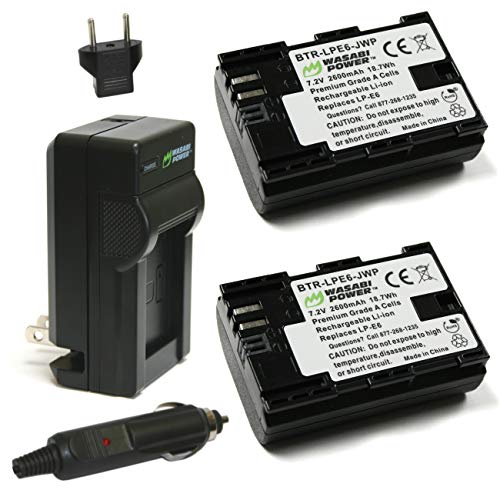
1. Wasabi Power LP-E6 Battery (2-Pack) and Charger Kit — best value kit
ASIN: B0049XGNKK — candidate. The Amazon US listing for this kit was indexed with the ASIN shown, the model number KIT-BTR-LPE6-LCH-LPE6-01 and explicit compatibility with the Blackmagic Design Pocket Cinema Camera 4K and 6K, but the live product page could not be read in full at the time of writing, so this pick is graded candidate rather than verified. Confirm stock and the current kit contents on the listing before you order.
Wasabi Power has been the default third-party answer for this camera since the Pocket 4K launched, and this kit is the reason: it pairs two LP-E6 cells with a compact wall charger, so a single purchase turns a one-battery camera into a three-battery rotation. The cells are rated at 7.2 volts and 2600mAh, which on paper is a healthy step up from the roughly 2000mAh cell the camera ships with. Even allowing for the optimism that third-party capacity ratings sometimes carry, two of these in rotation plus the battery that came with your camera covers most short shoots without any other power gear.
The included charger matters more than it looks. It charges the Wasabi cells and works with Canon original batteries too, and the kit’s charger accepts multiple power sources, including a fold-out mains plug, a 12-volt car adapter and a European plug adapter. On a location day that flexibility is genuinely useful: the charger can run from a wall socket in the green room or from a vehicle between setups, keeping the rotation fed. The batteries themselves also charge in Canon’s original charger, so this kit slots into an existing Canon shooter’s bag without forcing a second charging system.
Wasabi states that its batteries use premium Grade-A cells and backs the kit with a 3-year manufacturer warranty with US-based support. For a consumable that you will cycle hard, that warranty and a real support address are worth weighing against cheaper no-name multipacks. The honest limitations: third-party cells can vary in how accurately they report charge to Blackmagic’s cameras, which is why the voltage-readout habit described above matters, and no LP-E6 cell of any brand turns the Pocket 4K into an all-day camera. This kit’s job is to make swaps cheap and frequent, and at that job it is the strongest value on this page.
2. Wasabi Power LP-E6 Battery (1-Pack) — best single spare
ASIN: B0041MY32Y — candidate. The Amazon US listing for the single battery was indexed with this ASIN, the model number BTR-LPE6-JWP-001, a 2600mAh capacity and explicit BMPCC 4K and BMPCC 6K compatibility, but the live product page could not be fully read at the time of writing, so it is graded candidate. Check the listing itself for current availability before buying.
This is simply the kit’s battery sold on its own, and it earns its place for shooters who already own a charger they like. If your bag already contains a Canon LC-E6 charger or a dual USB charger from another system, paying for another wall charger in every purchase is waste. The single cell carries the same headline specification as the kit batteries: 7.2 volts, 2600mAh, lithium-ion, about 76 grams, fully compatible with the Canon LP-E6 and LP-E6N fitment the Pocket 4K uses, and chargeable in the Canon original charger.
Buying singles also lets you build your rotation gradually and replace individual tired cells later. Camera batteries age by cycle count and by calendar, and a working set rarely wears out evenly; the cell that lived on the camera during a hot summer of exteriors will fade first. Being able to retire and replace one pack at a time, from the same product line so behaviour stays predictable, is a small operational advantage that adds up over years of ownership. Wasabi’s 3-year warranty applies here as well, according to the listing information.
The trade-off against the kit is obvious: one cell is one cell. A single spare doubles your shooting time compared with the in-box battery alone, but it does not create a rotation, because while you shoot on the spare there is nothing on the charger unless you also stop to charge the first battery. Most buyers should treat this single pack as a top-up to an existing set rather than as their only purchase.
3. Blackmagic Design LP-E6 Battery — best official cell
ASIN: N/A — Blackmagic Design sells this battery under the model code BATT-LPE6M/CAM through camera dealers, and an Amazon US listing with a confirmable ASIN could not be verified at the time of writing, so no code is printed here rather than risk publishing a wrong one. Search the model code BATT-LPE6M/CAM to reach the current listing from a reputable seller.
The official Blackmagic LP-E6 battery is the cell the camera’s runtime figures are based on: a rechargeable lithium-ion pack rated at 2000mAh and 7.4 volts, designed by the camera’s maker for the Pocket Cinema Camera 4K and the earlier Micro cameras. Its capacity figure is lower than the Wasabi rating, and in exchange you get the most predictable behaviour of any cell on this page. The camera’s battery reporting was calibrated around this pack and the Canon originals, so the percentage and voltage behaviour is as trustworthy as this camera gets, and there is no compatibility question to research at all.
That predictability is why many professionals keep at least one or two official cells in the kit even when the bulk of the rotation is third-party. The official cell is the reference: if a third-party battery seems to be misbehaving, swapping in the Blackmagic cell tells you immediately whether the problem is the battery or the camera. It is also the safest choice for shooters whose clients or insurers prefer first-party consumables in the camera.
The downsides are equally clear. You pay a first-party premium for a lower stated capacity, and the official cell is sold singly without a charger, so building a full day’s rotation from official cells alone is the most expensive route on this page. As a reference cell and a reliability anchor it makes sense; as the whole strategy, it rarely does.
4. Canon LP-E6NH — best first-party Canon option
ASIN: N/A — the LP-E6NH is Canon’s current high-capacity member of the LP-E6 family and is sold widely through camera dealers, but an Amazon US listing with a confirmable ASIN could not be verified at the time of writing, so no code is printed here. Search the exact model name LP-E6NH on Amazon US or at a camera dealer to reach the current listing.
Canon created the LP-E6 format, and the LP-E6NH is the most capable version Canon has made of it, offering higher capacity than the original LP-E6 and the LP-E6N while keeping the same physical fit. For BMPCC4K owners, the appeal is the same as the Blackmagic cell’s, only stronger on capacity: a first-party pack whose charge reporting, protection circuitry and build quality are as controlled as this battery format offers. Canon rates its LP-E6 family cells conservatively, so the real-world gap between an LP-E6NH and a third-party cell with a bigger printed number is usually smaller than the labels suggest.
Compatibility deserves one careful sentence. The Pocket 4K was designed around the LP-E6, and LP-E6N cells are widely used in it; the LP-E6NH shares the family fit and is used by many Pocket shooters, but because it is the newest variant, confirm the return policy of your seller and test the cell in your camera well before an important shoot, exactly as you should with any battery that your shoot depends on. That caution applies to every pick in this guide, but it is worth stating plainly for the newest format revision.
Choose the Canon cell if you already shoot Canon stills bodies and want one battery pool that serves both systems with zero guesswork, or if first-party provenance matters more to you than the last few minutes of runtime per charge. Choose it knowing it is, like the Blackmagic cell, a single battery with no charger in the box.
How many BMPCC4K batteries do you actually need?
Work backwards from the camera’s appetite. Plan on roughly 35 to 60 minutes per LP-E6 cell depending on codec, frame rate, screen brightness and accessories. A two-hour interview shoot with setup and retakes therefore needs three to four cells if nothing is charging during the session, or two cells plus a charger running beside the camera if you have mains power and a disciplined rotation. A full day of documentary or wedding work realistically means six or more cells and a multi-bay charger, with spent batteries going straight onto charge and a strict charged-versus-spent system, such as charged cells stored contacts-down in one pouch and spent cells contacts-up in another.
Charging speed is the hidden half of the equation. The single-bay charger in the Wasabi kit is fine for topping up between shoots, but high-volume shooters should know that the rotation only works if cells return to service as fast as the camera consumes them. If you regularly drain a battery in 45 minutes and your charger needs several hours per cell, arithmetic defeats you no matter how many batteries you own, and that is the point at which shooters graduate to multi-bay chargers or external power. Those accessories are outside this guide’s scope, because this guide is strictly about the LP-E6 batteries themselves, but the maths is worth doing before a big job.
Battery care for cinema camera cells
LP-E6 packs are lithium-ion, and a few habits extend their useful life considerably. Store them at partial charge rather than brim-full or empty if they will sit for weeks. Keep them out of hot vehicles, because heat is the fastest way to permanently shrink a lithium cell’s capacity. Label each battery with a number and rotate them in order, so the whole set ages evenly and a weakening cell reveals itself in your notes rather than on a paid shoot. Retire any pack that swells, runs noticeably shorter than its siblings, or makes the camera’s voltage readout fall unusually fast in the first minutes after a full charge. And never mix a suspect third-party cell into a critical shoot to save a small amount of money; the footage is worth more than the battery.
Verdict
For most BMPCC4K owners, the Wasabi Power two-pack kit (ASIN: B0049XGNKK, candidate) is the purchase that fixes this camera’s battery problem in one step: two high-capacity cells, a flexible charger, and a 3-year warranty behind them. Add single Wasabi cells (ASIN: B0041MY32Y, candidate) to grow the rotation. Keep one official Blackmagic cell, or a Canon LP-E6NH, as your reference and reliability anchor; both are listed here with ASIN: N/A because their Amazon US codes could not be confirmed, and both should be bought by exact model name from a reputable seller. Whichever mix you choose, confirm fitment and stock on the listing before ordering, switch the camera’s battery display to voltage, and carry at least twice as many cells as your longest unbroken take demands. Do that, and the Pocket 4K’s only real weakness stops being a weakness at all.