Key takeaways
- Five turntable cartridges for vinyl sound and clarity, from elliptical to Shibata styli, with output, tracking force, and fit notes compared.
A cartridge is the part of a turntable that turns grooves into music, and it shapes the sound more than any other single upgrade. The right cartridge gives clear vocals, defined bass, and quiet inner grooves, while the wrong one adds sibilance, mistracks on loud passages, and wears your records faster than it should.
This roundup covers five turntable cartridges for vinyl sound and clarity, with stylus shape, output, and tracking force for each.
As an Amazon Associate, we earn from qualifying purchases.
Quick Answer
For most vinyl listeners, the Audio-Technica AT-VM95E is the best place to begin: a bonded elliptical stylus, a strong 4.0-millivolt output, and a body that accepts every VM95 replacement stylus. If you want a brighter, more detailed sound, take the Ortofon 2M Red. Warmth seekers should take the Nagaoka MP-110, detail seekers the AT-VM95SH, and vocal lovers the Grado Prestige Green3.
1. Audio-Technica AT-VM95E

The AT-VM95E is the default cartridge in this roundup, and its upgrade path is the reason. It uses a 0.3 by 0.7 mil bonded elliptical stylus on an aluminium cantilever, with a 4.0-millivolt output and a frequency response from 20 to 22,000 hertz. It fits any half-inch mount turntable and replaces the older AT95E and AT95EX.
What makes it special is the shared VM95 body. All six VM95 cartridges use the same electromagnetic body, so any of the six replacement styli fits this cartridge. Begin with the elliptical stylus, then move to a Microlinear or Shibata stylus later without buying a new cartridge body.
The tracking force runs from 1.8 to 2.2 grams, with 2.0 grams recommended, and the stylus lasts about 300 hours. An unverified code circulated for this cartridge but was never confirmed by any page; this pick uses the verified ASIN, confirmed by an amazon.com crawl naming the product, the model, and the code. Buy the standalone cartridge, not the headshell combo, which is a different listing.
Specs
- Type: VM dual moving magnet
- Stylus: 0.3 by 0.7 mil bonded elliptical
- Output: 4.0 millivolts
- Frequency response: 20 to 22,000 hertz
- Tracking force: 1.8 to 2.2 grams
- ASIN: B07JXD79Q1
2. Ortofon 2M Red

The 2M Red is the classic Ortofon in this roundup, for listeners who want detail and openness. It uses a tipped elliptical diamond with split pole pins and copper wire, giving a lively, detailed sound with clear highs and a firm bass. Its output is 5.5 millivolts, the highest in this roundup, so it drives a phono stage easily.
The 2M Red ships on many turntables, and that familiarity is a strength. It is easy to align and set up, and its sound is well known, so you can read comparisons against almost any other cartridge before you buy.
Buy the standalone cartridge, not the pre-mounted version. The pre-mounted 2M Red on a headshell uses a different ASIN and is discontinued by the manufacturer. This pick is the standalone 2M Red, and its listing shows strong recent demand on the marketplace.
Specs
- Type: Moving magnet
- Stylus: Tipped elliptical diamond
- Output: 5.5 millivolts
- Frequency response: 20 to 22,000 hertz
- Tracking force: 1.6 to 2.0 grams
- ASIN: B000WMCEKK
3. Nagaoka MP-110
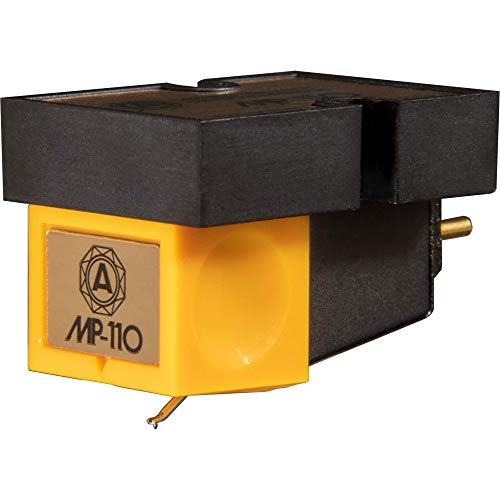
The MP-110 is the warm pick in this roundup. It uses Nagaoka’s Moving Permalloy design with a 0.4 by 0.7 mil elliptical stylus, and its sound is smooth, full, and slightly warm, with a rich midrange that suits vocals, jazz, and acoustic records.
Its output is 5.0 millivolts with a tracking force from 1.5 to 2.0 grams, and the cartridge weighs 6.5 grams, which suits most medium-mass tonearms. The replacement stylus is the JN-P110, and it is easy to find, so you can keep the cartridge running for years by changing the stylus alone.
One caution belongs with this pick. The stylus lasts about 250 hours, shorter than the Ortofon’s roughly 1,000 hours, so budget for a replacement sooner. Also, do not confuse the cartridge with its replacement stylus, which uses a different ASIN. This pick is the MP-110 cartridge itself, and the stylus alone is a different listing.
Specs
- Type: Moving Permalloy
- Stylus: 0.4 by 0.7 mil elliptical
- Output: 5.0 millivolts
- Tracking force: 1.5 to 2.0 grams
- Weight: 6.5 grams
- ASIN: B002SDU67Y
4. Audio-Technica AT-VM95SH

The AT-VM95SH is the detail pick in this roundup, and it shares the VM95 body with the AT-VM95E above. The difference is the stylus: a nude Shibata diamond instead of a bonded elliptical. The Shibata shape contacts more of the groove wall, giving better high-frequency detail, cleaner inner grooves, and less sibilance on loud vocals.
Its output is 3.5 millivolts with a tracking force from 1.8 to 2.2 grams, and the Shibata stylus lasts about 800 hours, more than twice the elliptical stylus. Because it shares the VM95 body, it accepts any VM95 replacement stylus, so you can move between the elliptical, Microlinear, and Shibata styli without changing the cartridge.
Treat this as a verify-before-you-buy pick. The ASIN is confirmed by an amazon.com crawl naming the product, the model, and the code, but that crawl is older than the others in this roundup, so confirm the listing is in stock and shows the AT-VM95SH before you order. Do not buy the headshell combo by mistake; this pick is the standalone cartridge.
Specs
- Type: VM dual moving magnet
- Stylus: Nude Shibata
- Output: 3.5 millivolts
- Frequency response: 20 to 25,000 hertz
- Tracking force: 1.8 to 2.2 grams
- ASIN: B07JXD893J
5. Grado Prestige Green3

The Prestige Green3 is the warm vocal pick in this roundup, and the only moving iron cartridge here. Grado’s moving iron design uses a patented flux-bridger system with a three-piece OTL cantilever and an elliptical diamond, and its sound is famous for a rich, full midrange that suits vocals, saxophones, and acoustic instruments.
The Green3 is hand-selected from Black3 production runs: Grado tests each Black3 cartridge and promotes the ones that meet higher test limits to Green3. It is hand-assembled in Brooklyn, New York, with a 5-millivolt output and a 1.5-gram tracking force. It fits a standard half-inch mount, and any Prestige stylus fits its body.
One note on the choice: the Black3 is the better-known model, but no ASIN surfaced for it after repeated searches, so this roundup uses the Green3, its hand-selected sibling, sold through the official Grado store on the marketplace. Confirm the listing says Prestige Green3 before you order.
Specs
- Type: Moving iron
- Stylus: Elliptical diamond
- Output: 5 millivolts
- Tracking force: 1.5 grams
- Cantilever: Three-piece OTL
- ASIN: B08CDYK22L
How to Choose a Turntable Cartridge
Match the mount to your tonearm first. Most cartridges here use a standard half-inch mount with two screws, which fits most turntables. Some tonearms use a different mount or a fixed headshell, so check your tonearm before you order. A cartridge that does not fit your mount is useless, however good it sounds.
Pick a stylus shape for the detail you want. A conical stylus is the simplest and most forgiving, an elliptical stylus gives more detail and better tracking, and a Microlinear or Shibata stylus gives the most detail and the cleanest inner grooves. Finer styli cost more and need careful alignment.
Check the output against your phono stage. Output is measured in millivolts, and most moving magnet cartridges give between 3.5 and 5.5 millivolts. A higher output drives a phono stage more easily, while a lower output needs more gain. All five picks here are high-output designs that work with a standard moving magnet phono input.
Set the tracking force with a gauge, not by feel. Every cartridge lists a tracking force range, and the right number sits inside it. Too light and the stylus mistracks and damages records; too heavy and it wears records and the stylus faster. A small digital gauge costs little and removes the guesswork.
Plan for the stylus, not just the cartridge. A stylus lasts a few hundred hours, and a worn stylus damages records. Check the replacement stylus price and availability before you buy the cartridge, and prefer a cartridge whose stylus you can replace without buying a new body. The VM95 family and the Grado Prestige line both allow that.
Who Should Skip This Roundup
Skip this roundup if your turntable has a fixed cartridge that cannot be changed. Some entry turntables glue or rivet the cartridge in place, and no pick here will fit them. Check your turntable manual before you order, and if the cartridge is fixed, upgrade the turntable instead.
Skip the Shibata and Microlinear styli if you do not want to align a cartridge carefully. Finer styli reward careful setup and punish sloppy alignment with sibilance and mistracking. Take the elliptical AT-VM95E or the Ortofon 2M Red if you want a cartridge that is forgiving to set up.
Skip the Grado if your turntable has a hum problem with moving iron cartridges. Grado cartridges can pick up hum from some motors and power supplies, especially on turntables with the motor close to the platter. If your deck is known for hum, take a moving magnet pick instead.
Finally, skip any pick whose listing you cannot confirm. The AT-VM95SH rests on an older crawl, and the Grado Green3 rests on a manual page rather than a marketplace crawl. If either listing looks stale or shows the wrong model, take the AT-VM95E, the Ortofon 2M Red, or the Nagaoka MP-110, which carry stronger verification.
FAQ
How long does a turntable cartridge stylus last?
An elliptical stylus lasts about 300 hours, a Shibata stylus about 800 hours, and a Microlinear stylus about 1,000 hours. The Nagaoka MP-110 in this roundup lasts about 250 hours. Replace the stylus when the sound turns dull or sibilant, and never play records with a worn stylus, since it damages grooves.
Can I upgrade the stylus without buying a new cartridge?
Yes, if the cartridge family allows it. All six VM95 styli fit the same VM95 body, so an AT-VM95E owner can move to a Microlinear or Shibata stylus later. Grado Prestige styli also fit any Prestige body. Check the family before you buy.
What is the difference between a moving magnet and a moving iron cartridge?
A moving magnet cartridge moves a magnet near fixed coils, while a moving iron cartridge moves a small piece of iron near fixed coils and a fixed magnet. Both work with a standard moving magnet phono input. Moving iron designs, like the Grado here, are known for a warm midrange, while moving magnet designs cover a wider range of sounds.
Do I need a separate phono stage for these cartridges?
Most turntables with a built-in phono stage work with every cartridge in this roundup, since all five are high-output designs for a moving magnet input. If your turntable has no phono stage and your amplifier has no phono input, you need a separate phono stage between the turntable and the amplifier.
Final Verdict
For most vinyl listeners, the Audio-Technica AT-VM95E is the cartridge to buy: clear, easy to set up, and upgradeable to any VM95 stylus later. For a brighter, more detailed sound, take the Ortofon 2M Red. Warmth seekers should take the Nagaoka MP-110, detail seekers the AT-VM95SH, and vocal lovers the Grado Prestige Green3. Match the cartridge to your tonearm and set the tracking force with a gauge.