We independently review everything we recommend. When you buy through our links, we may earn a commission. As an Amazon Associate we earn from qualifying purchases.
4 Best Keyboard Amps for Small Live Venues (November 2026)
Compare portable keyboard amplifiers for small live venues, with channel counts, speaker sizes and outputs checked against each Amazon product listing.
Compare portable keyboard amplifiers for small live venues, with channel counts, speaker sizes and outputs checked against each Amazon product listing.
Choosing a keyboard amp for a small live venue is really a decision about range and headroom. A piano or synth patch spans deep bass notes and bright top-end detail at the same time, so the amp has to stay clean across that whole span at room-filling volume, without a house PA to help it. Buy too small and the low notes distort first, usually in the middle of a set.
This guide is for solo keyboard players, singing keyboardists, duos and small worship or café acts who carry their own sound. Every model below was picked from its Amazon US listing, using the product name and the specifications printed on that listing: the Roland KC-200 for players who need real mixing onboard, the Peavey KB 1 and Donner DKA-20 as simple two-channel options, and the Coolmusic DM20 for cable-free backing tracks in the smallest rooms.
Quick Picks
As an Amazon Associate we earn from qualifying purchases
Product
Best for
Key spec from title
Roland KC-200
Small venues where the amp is the whole PA
100-watt 4-channel mixing keyboard amplifier
Peavey KB 1
Simple, durable amp for rehearsals and small rooms
20-watt 1×8 keyboard amp
Donner DKA-20
Singing keyboardists who need a mic input
20-watt keyboard amp with aux in and two channels
Coolmusic DM20
Tiny rooms and backing tracks without cables
20W Bluetooth personal monitor amplifier with USB interface
How to Choose
Match the wattage to the room, not the stage
Wattage figures only make sense against the size of the room and the noise you compete with. A quiet café set with one keyboard sits comfortably in the 20-watt class, where the amp works more like a personal monitor that the front tables can hear clearly. A bar room with talking guests, an espresso machine and a second musician eats that headroom quickly, and a 100-watt amp like the KC-200 keeps the same patches clean instead of grainy. Judge by your loudest regular room, not your quietest one.
Speaker size decides how the low notes survive
Keyboards punish small speakers at the bottom of the range. An 8-inch driver, as fitted to the Peavey KB 1 and the Donner DKA-20, handles most piano and synth work in small rooms, but sustained bass pads and left-hand bass lines will thin out at volume. Two-way designs that add a separate tweeter keep cymbals, string patches and the attack of piano notes distinct instead of smeared. If your set leans on organ, synth bass or full-range stage piano sounds, treat speaker size as a hard requirement rather than a nice extra.
Count your channels before you count features
Small-venue players rarely plug in just one thing. A second keyboard, a drum machine, a phone for backing tracks and a vocal microphone all compete for inputs, and running out of channels means unplugging gear mid-set. Two-channel amps suit a single keyboard plus one extra source. A four-channel mixer section, like the one on the KC-200, covers a main board, a second synth, tracks and a mic at once. Check whether the microphone input is a proper XLR socket, because that decides which mics you can use.
Portability and outputs decide how the amp works live
Portable means more than light. It means one trip from the car, a handle you trust, and a cabinet that fits beside a keyboard stand on a crowded floor. Weight in this group runs from roughly sixteen pounds to around thirty, which is the difference between carrying the amp in one hand and planning a separate trip. Outputs matter just as much: a headphone socket allows silent warm-ups, and a line or D.I. output lets a venue plug your amp into its own system on the nights when one is available.
The 4 Best Options
Roland KC-200
Top Pick
Roland KC-200
Best for: Solo acts and duos playing cafés, bars and small halls with no house PA.
Output wattage: 100 watts
Channels: 4 line input channels plus a dedicated aux input
The KC-200 is the pick here for players whose amp has to do the whole job in a small venue: keyboard sound, vocal microphone and backing tracks from one box. Its four-channel mixer means a main keyboard, a second synth or module, a phone and a mic can stay plugged in all night, with the XLR input on the first channel taking a proper vocal microphone. At 100 watts it holds piano and organ patches together at bar-room volume where the smaller amps in this list start to strain, and it still stays in one-person carry territory.
Peavey KB 1
Runner-Up
Peavey KB 1
Best for: Rehearsal spaces, small worship setups and quiet café sets with a single keyboard.
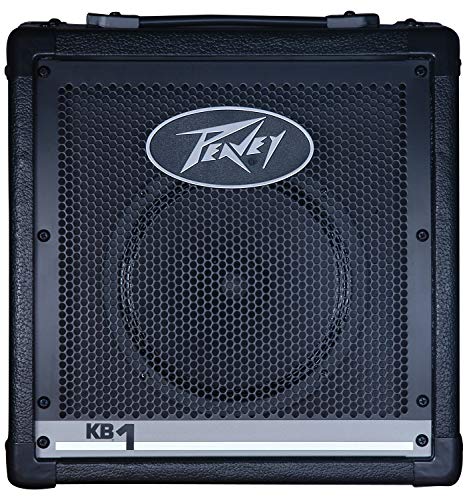
The KB 1 is the straightforward option in this group: two channels, an 8-inch extended range speaker and per-channel EQ, with nothing on the panel you need a manual to understand. That simplicity suits rehearsal rooms, small church setups and café corners where the amp gets set up fast and moved often. Twenty watts will not fight a loud room, but for one keyboard at modest volume it delivers a clean, focused sound, and the headphone output covers silent practice between gigs. At sixteen pounds it is also the easiest carry in this roundup.
Donner DKA-20
Donner DKA-20
Best for: Solo singing keyboardists playing restaurants, cafés and small private events.
Solo singing keyboardists playing restaurants, cafés and small private events.
Watch out for
Twenty watts is personal-monitor territory in a noisy room, so confirm your venue size is genuinely small before choosing it as your only sound source.
The DKA-20 is aimed at the singing keyboard player. Its listing leads with microphone input support alongside two channels and an aux input, so a keyboard, a mic and a phone for tracks can run through one small box, which is exactly the setup a solo café or restaurant act needs. The two-way speaker pairs an 8-inch woofer with a 2-inch tweeter, and a three-band EQ shapes low, mid and high frequencies. A D.I. output is a useful extra at this size, letting a venue feed your sound into its own mixer when one exists.
Coolmusic DM20
Coolmusic DM20
Best for: Very small rooms, ceremony and background sets, and players who stream backing tracks.
The DM20 takes a different route from the other amps here: it is a compact personal monitor with Bluetooth and a USB interface, built for the smallest end of live work. Twenty watts through a 6.5-inch woofer and 2-inch tweeter will not fill a bar, but for a wine bar corner, a small ceremony setup or a busking-style indoor set it keeps a keyboard present without dominating the room. Bluetooth backing tracks remove one cable from the setup, and the listing includes an e-drum noise-reduction cable, which makes it a flexible spare for players who double on electronic drums.
Which One Fits Your Situation
You play cafés and bars with no house PA
Take the Roland KC-200. It is the only amp here with the wattage and the four-channel mixer to run keyboards, a vocal mic and backing tracks together at real room volume. The smaller models work as monitors in that setting, but the KC-200 is the one that can be the entire sound system for the night.
You need one simple amp for rehearsals and a small church hall
The Peavey KB 1 fits this job well. Two channels cover a keyboard and one extra source, the controls take seconds to set, and the sixteen-pound cabinet is easy to move between rooms. The headphone output also helps when the hall is shared and you need to warm up quietly before a service or rehearsal starts.
You sing and play at the same time in restaurants
Choose the Donner DKA-20. Microphone input support is the deciding feature for a singing keyboardist, and the aux input keeps backing tracks in the same box. Its three-band EQ gives you a quick way to keep vocals clear over piano, and the D.I. output covers venues that would rather take a feed from you than use your amp alone.
Your gigs are tiny rooms and background sets
The Coolmusic DM20 suits background music work where volume stays low and space is tight. Bluetooth tracks and a compact footprint make setup almost invisible, which matters in ceremony and dining settings. Keep your expectations matched to its size: it is a monitor for intimate rooms, not a substitute for a full-size keyboard amp.
Common Mistakes
Buying by wattage alone and ignoring speaker size, then finding that bass-heavy patches distort long before the amp reaches its rated volume.
Forgetting to count inputs, so the vocal microphone or backing-track phone has nowhere to plug in when the set starts.
Choosing a guitar amp instead of a keyboard amp, which colours the sound and handles the low end of piano and synth patches poorly.
Skipping the headphone or line output check, then having no way to warm up silently or feed a house system when the venue offers one.
Assuming a 20-watt personal monitor will cover a noisy bar, when that class of amp is built for quiet rooms and close listening.
Frequently Asked Questions
How many watts does a keyboard amp need for a small venue?
For a quiet café or restaurant set, a 20-watt amp is usually enough for listeners sitting close. Rooms with crowd noise, a second musician or a singer competing for the same box call for more headroom, which is where a 100-watt model like the Roland KC-200 earns its place. Match the amp to your loudest regular room rather than your average one.
Can I plug a microphone into a keyboard amp?
Yes, if the amp provides a microphone input. The Donner DKA-20 lists microphone input support, and the Roland KC-200 takes an XLR microphone on its first channel. Amps with only line-level inputs, such as the Peavey KB 1, are not designed for a microphone plugged straight in, so check the input types on the listing before you buy.
Is a keyboard amp better than a portable PA speaker for keys?
A keyboard amp is voiced for the full range of a keyboard and usually includes a small mixer, which suits players who plug in several sources. A PA speaker can go louder for its size but often offers fewer inputs and less EQ control per channel. For a solo or duo act in a small venue, the amp’s built-in mixing is usually the more practical package.
Can these amps handle electronic drums or a bass guitar as well?
The listings for several models here name electronic drums as a supported use, and the Coolmusic DM20 is sold as a monitor for both drums and keyboards. Bass guitar at low volume is fine through most keyboard amps because the speakers are full-range, but sustained high-volume bass can overwork a small woofer, so keep levels moderate and listen for distortion.
B
Beckykinkead Editorial Team
We compare specs, materials and verified owner reviews before a product earns a spot. Rankings are never paid.
Affiliate disclosure. As an Amazon Associate we earn from qualifying purchases at no extra cost to you. Prices accurate as of the date shown.
Looking for the best dual boiler espresso machines for couples? Compare four machines built for two-drink mornings, steam-while-brewing speed and routines.
Compare the best compact swim spas for outdoor renovation planning, from 12-foot trainers to 13-foot family models, and plan your pad, power, and access.
Four rear-deploying mechanical broadheads compared on cutting diameter, blade retention and ferrule build, with the specs that matter for compound bows.
Compare five computer desks with real dimensions, storage, and power features stated in their listings, and pick the size that fits your room and setup.



 Coolmusic DM20