Key takeaways
- Find the best battery life tester for real capacity in mAh: slot analyzers, a bench discharge tester, and a pulse-load checker compared by test method, cell types, and accuracy.
As an Amazon Associate we earn from qualifying purchases.
Affiliate Disclosure: This article contains affiliate links. If you buy through a link on this page, we may earn a commission at no extra cost to you. Product specifications are taken from the manufacturer and seller listings for each tester, not from detailed research by us.

A battery can show a healthy voltage on a multimeter and still die ten minutes into real use. Voltage is a snapshot. Battery life — how much work a cell can actually do before it fades — is a measurement, and measuring it takes a controlled discharge. That is what a battery life tester does: it drains a cell at a known current, down to a defined cutoff voltage, and counts the milliamp-hours and milliwatt-hours delivered along the way. The result is the number that tells you whether a rechargeable cell is still close to its rated capacity, whether a bargain cell was ever honest, and whether a matched set for a flashlight, camera trap, or sensor node is still matched at all.
This guide compares four testers that approach that job in three different ways. Two are slot analyzers that charge, discharge, and grade individual cylindrical cells. One is a bench electronic load that can test whole packs and power banks as well as single cells. One is a pulse-load checker that gives a fast state-of-power verdict in seconds without a full discharge. All four are battery life testers in the same sense — tools for judging remaining life and capacity — but they suit very different drawers, benches, and budgets of patience. Read the section on test methods first, because the right pick depends less on brand than on which kind of answer you actually need.
Quick comparison
| Tester | Test method | What it measures | Cell types | Best for |
|---|---|---|---|---|
| Opus BT-C3400 | Slot analyzer, charge-test cycle | Capacity in mAh, internal resistance, voltage, current | Li-ion, NiMH, NiCd cylindrical cells | Most households grading AA, AAA, and 18650 cells |
| SkyRC MC3000 | Slot analyzer, programmable programs | Capacity, internal resistance, cycle history, logged curves via app and PC | Li-ion, LiFePO4, LiHV, NiMH, NiCd, NiZn, and more | Enthusiasts who want control and data logging |
| ZKE Tech EBC-A10H | Bench electronic load and charger | Capacity in Ah and energy, discharge curves on a PC | Single cells, packs, power banks, lead-acid and lithium packs within its voltage range | Pack builders and anyone testing more than loose round cells |
| ZTS MBT-1 | Pulse-load checker | State of charge and state of power as a percentage-style LED verdict | More than 40 household, photo, and button cell types | Fast sorting of mixed household batteries |
How a battery life test actually works
Every meaningful life test has the same skeleton. The tester connects a known load, holds either the current or the power steady, watches the voltage fall, and stops at a cutoff that matches the chemistry. For a lithium-ion cell that cutoff is typically around 2.8 to 3.0 volts under load. For a nickel-metal hydride cell it is around 1.0 volt. Stop too early and a good cell looks weak. Stop too late and you can damage the cell you were trying to save, especially a lithium cell with no protection circuit.
Three numbers matter most in the result. Capacity in milliamp-hours tells you how much charge the cell delivered. Energy in milliwatt-hours tells you how much work it delivered, which is the fairer comparison between chemistries at different voltages. Internal resistance tells you how much the cell sags under load — a cell can keep most of its capacity and still become useless in a high-drain device because its resistance has climbed. A good life tester reports at least the first of these, and the better slot analyzers in this guide report all three.
Discharge rate changes the answer, and honest testers let you choose it. A gentle discharge flatters a tired cell. A heavier discharge, closer to what your device actually draws, exposes weak cells that a slow test would pass. When you compare two cells, test them at the same rate, at a similar temperature, and starting from a full, rested charge. Otherwise you are comparing test conditions, not batteries.
Finally, separate two jobs that are often confused. A full capacity test takes hours and gives you a number you can write on the cell with a marker. A pulse-load check takes seconds and gives you a verdict — strong, marginal, or replace — under a brief, realistic load. Both are legitimate life testing. The first is for grading and matching cells you depend on. The second is for clearing out a drawer of mixed household batteries without spending a weekend on it.
1. Opus BT-C3400 — best slot analyzer for most people
ASIN: B07T941JCF (candidate — see the evidence note at the end of this article)
The Opus BT-C3400 is a four-slot charger, discharger, and analyzer for cylindrical rechargeable cells, and its charge-test mode is the classic battery life test: it charges a cell, discharges it at a chosen current while counting capacity, then charges it again so the cell comes off the tester ready to use. Each of the four slots works independently, so you can grade four cells at four different settings at once, and the backlit display for each slot reports capacity, voltage, current, elapsed time, and internal resistance.
According to the manufacturer’s manual, the BT-C3400 handles nickel-metal hydride and nickel-cadmium cells in AAAA, AAA, AA, A, C, and SubC sizes, and lithium-ion cells in sizes including 10440, 14500, 14650, RCR123A, 17500, 17670, 18350, 18500, 18650, protected 18650, 25500, 26500, and 26650. Charge current is adjustable from 200 mA up to 2,000 mA on the outer slots, with 1,000 mA available across all four slots at once. Discharge current runs up to 1,000 mA for lithium cells and 700 mA for nickel-based cells, and the maximum measured charging capacity is 20,000 mAh, which comfortably covers any single cylindrical cell you are likely to test.
Five modes per slot cover the whole life-testing workflow. Charge Test is the headline mode for this guide. Discharge shows how a cell behaves on the way down without the recharge step. Discharge Refresh cycles a nickel-based cell repeatedly, which can recover some usable capacity in older NiMH and NiCd cells that have been stored or shallow-cycled. Quick Test gives a fast internal resistance reading when you only need a health signal, not a full grade.
The honest limits are worth stating. This is a cylindrical-cell tool only — it cannot test a battery pack, a power bank, a coin cell, or a lead-acid battery. A full four-cell capacity run takes hours, and the built-in fan that cools the unit during discharge is audible in a quiet room. The BT-C3400 is also the same hardware family as the earlier BT-C3100 sold under a different model number for a particular dealer channel, so do not pay a novelty premium for the badge; what matters is the version and the included wall and car adapters. For a household or hobby bench built around AA, AAA, and 18650 cells, though, this remains the most direct route from guessing about battery life to knowing it.
2. SkyRC MC3000 — best for programmable, logged testing
ASIN: B00SSFRES0 (candidate — see the evidence note at the end of this article)
Where the Opus is an appliance, the SkyRC MC3000 is an instrument. It is a four-slot universal charger and analyzer whose programs you define yourself: charge and discharge current, cutoff voltage, rest periods, cycle counts, and break-in routines for new nickel-based cells. Manufacturer specifications list charge current adjustable from 0.05 A to 3 A per slot and discharge current from 0.05 A to 2 A, across a chemistry list that runs from lithium-ion, lithium iron phosphate, and high-voltage lithium variants through NiMH, NiCd, NiZn, and eneloop-type cells, in sizes from small cylindrical cells up to 26650.
For life testing, the difference that matters is repeatability and records. Because you set the exact discharge conditions, you can retest a cell a year later under the identical program and trust the comparison. The MC3000 also connects to a phone app over Bluetooth and to PC software, so discharge curves and capacity results can be logged instead of scribbled on the cell — useful if you maintain a fleet of cells for lights, radios, or field gear and want a retirement rule based on data, such as pulling any cell that falls below a set share of its rated capacity.
That capability comes with a learning curve. The menu system rewards users who read the manual and punishes casual button pressing, and a badly chosen program — too high a discharge rate, too low a cutoff for the chemistry — produces misleading numbers or stressed cells. It also costs meaningfully more in time, if not only in money, than a simpler analyzer. Choose the MC3000 if you test cells often, care about curves and cycle history, or work with several chemistries. If you only want to know which of your AA and 18650 cells are still good, the Opus above answers the same question with far less setup.
3. ZKE Tech EBC-A10H — best for packs, power banks, and bench work
ASIN: B08L3MQD9F (candidate — see the evidence note at the end of this article)
The EBC-A10H, sold under the ZKE Tech name and various seller brands, leaves the slot format behind entirely. It is a bench electronic load and charger in one box, with four-wire Kelvin connections — separate current and voltage-sense leads — so the voltage it reports is the voltage at the battery, not the voltage lost in the test leads. That detail is why bench testers can grade large cells and packs more honestly than a spring-contact slot.
The listing specifications describe a discharge range of 0 to 30 volts at 0.05 to 10 amps, with constant-current and constant-power discharge modes, and a charging side that handles nickel-based, lithium, lithium iron, and lead-acid batteries at up to 5 amps. An automatic charge-discharge-charge cycle runs a full capacity test unattended, the display reports voltage, current, time, capacity, power, and energy, and a dedicated USB-to-TTL cable connects the unit to PC software that draws discharge curves and supports calibration and firmware updates. Capacity resolution is fine-grained: thousandths of an amp-hour below 10 Ah, which suits single cells, and hundredths up to 100 Ah, which suits the small packs this unit is really aimed at.
This is the tester to choose when the battery in question is not a loose round cell: a lithium pack you built or bought, a power bank whose real output you want to verify, a small lead-acid battery, or a cell in a holder wired to the bench. The trade-offs are setup and safety discipline. You supply the holder or leads, you choose the cutoff, and a wiring mistake is yours — there is no slot shaping your decision for you. The dedicated serial cable is not a standard USB cable, and the software experience is functional rather than polished. Treat it as bench equipment, give it ventilation, and never leave a high-current discharge of an unknown pack unattended.
4. ZTS MBT-1 — best fast checker for mixed household batteries
ASIN: B000FQG1XE (candidate — see the evidence note at the end of this article)
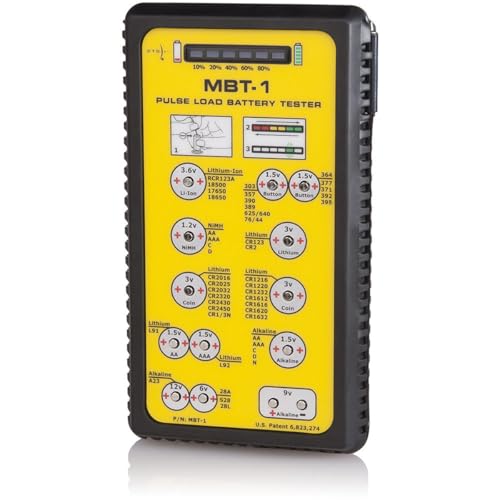
The ZTS MBT-1 answers a different version of the life question: not how many milliamp-hours remain, but whether this battery, today, can still do its job. It applies a pulse load sized for the battery type — a brief, realistic draw rather than a resting voltage check — and shows the result on a row of green, yellow, and red LEDs as a percentage-style state-of-power reading. A test takes two to three seconds.
The manufacturer’s data sheet credits the MBT-1 with testing more than 40 battery types: 1.5-volt alkaline, 1.2-volt NiMH and NiCd, 3-volt photo lithium, 3.6-volt lithium-ion cells such as RCR123A, 18500, 17650, and 18650 in non-regulated form, 6-volt and 9-volt batteries, and a long list of button and coin cells, selected by touching the battery to the marked contact points or using the flexible test lead for awkward shapes. The unit itself runs on four AA batteries, measures about 8 by 4.5 by 1.25 inches, and uses nickel-plated brass contacts.
Be clear about what it does not do. The MBT-1 does not charge anything, does not run a full discharge, and does not report milliamp-hours, so it cannot grade or match cells the way the two slot analyzers can, and it is not the tool for packs. Its strength is throughput and breadth: a drawer of mixed household, camera, and remote-control batteries can be sorted into keep, use-soon, and recycle piles in minutes, with a load-based verdict that a simple voltage meter cannot match. For many homes, that quick verdict is the battery life test they will actually perform, which is why this checker earns its place alongside the true capacity testers.
How to choose
Start with the battery, not the tester. If your life revolves around loose AA, AAA, and 18650 rechargeable cells, a slot analyzer is the natural fit: the Opus BT-C3400 for straightforward charge-test grading, the SkyRC MC3000 if you want programmable conditions and logged data across many chemistries. If you test packs, power banks, or lead-acid batteries, neither slot unit can help you — the bench load of the EBC-A10H, with its four-wire sensing and constant-power mode, is the correct tool. If your problem is a mixed drawer of primary household batteries and you want a verdict in seconds, the ZTS MBT-1 pulse-load checker is built for exactly that.
Then check three practical points. First, cutoff and chemistry support: the tester must stop a lithium discharge at a safe voltage for that chemistry, every time. Second, discharge rate: a tester limited to very gentle currents will flatter weak high-drain cells, so match the available rates to the devices you power. Third, records: if you maintain many cells, a display you must copy by hand will eventually stop you testing; logged or clearly per-slot results keep a grading habit alive.
How to get a trustworthy result
Charge the cell fully with the tester’s own charge mode, let it rest briefly, then run the capacity test at a moderate, repeatable rate. Write the measured capacity and the date on the cell. Retest under the same settings when you want a comparison, and retire lithium cells that have lost a large share of their rated capacity, swell, get hot, or show rapidly rising internal resistance. Never capacity-test a damaged, dented, or leaking cell, and never leave a first discharge test of an unknown pack running unattended. A tester measures life; it cannot make a failing battery safe.
Evidence note
Amazon blocked direct reads of the product pages during this review round, so every ASIN above is listed at candidate level: each code comes from an indexed Amazon US listing or a source quoting that listing’s Amazon page, with the model name and specifications matching, but live stock and offer status were not confirmed on the product page itself. Check the listing before buying, confirm the exact model and version on the page, and treat any listing that has quietly changed the product as a different product.
Bottom line
The best battery life tester is the one matched to your batteries and honest about its method. For most readers, the Opus BT-C3400 is the recommendation: a true charge-discharge-charge capacity test, per-slot internal resistance, and wide cylindrical-cell support in a tool that needs no programming. Step up to the SkyRC MC3000 for logged, programmable analysis, out to the ZKE Tech EBC-A10H for packs and bench work, and keep the ZTS MBT-1 by the drawer for fast, load-based verdicts on everything else. Any of the four replaces the oldest test of all — putting the battery in a device and hoping — with a number or a verdict you can act on.