We independently review everything we recommend. When you buy through our links, we may earn a commission. As an Amazon Associate we earn from qualifying purchases.
How Many Watts Does a Motorcycle Battery Have? A Plain Guide
How many watts does a motorcycle battery have? Cranking watts and watt-hours for 12V AGM motorcycle batteries, with five live picks and the math shown.
How many watts does a motorcycle battery have? Cranking watts and watt-hours for 12V AGM motorcycle batteries, with five live picks and the math shown.
Disclosure: As an Amazon Associate, this site may earn from qualifying purchases made through links on this page.
A 12V motorcycle battery holds roughly 100 to 170 watt-hours of energy and can deliver roughly 2,400 to 2,640 watts in a short cranking burst. Those are two different watt figures, and mixing them up is the most common confusion around this question. Watt-hours measure how much energy the battery stores, which decides how long it can run a load. Cranking watts measure how much power it can deliver in one hard push, which decides whether it can turn the engine over. Both come from the same simple formula, watts equals volts times amps, and this guide shows the math for five live 12V AGM motorcycle batteries so you can work out the numbers for your own bike.
The short answer for a typical mid-size bike battery is about 120 to 170 watt-hours of stored energy and about 2,400 watts or more of cranking power. A small scooter battery sits lower, near 100 watt-hours and 1,500 cranking watts or less, while a large touring battery sits higher. The five picks in this guide span 10 to 14 amp-hours and 200 to 220 cold cranking amps, which works out to 120 to 168 watt-hours and 2,400 to 2,640 cranking watts. The numbers below are general guidance for 12V lead-acid AGM batteries, not figures from practical use of the picks in this guide, and every figure comes from the listing for that battery.
Watts are not printed on most motorcycle battery listings, which is why this question comes up so often. Listings print volts, amp-hours, and cold cranking amps instead, and watts hide inside those three numbers. Multiply volts by amp-hours and you get watt-hours. Multiply volts by cold cranking amps and you get cranking watts.
At a Glance
Stored energy, typical 12V bike battery: about 120 to 170 watt-hours (12 volts times 10 to 14 amp-hours)
Cranking power, typical 12V bike battery: about 2,400 to 2,640 watts (12 volts times 200 to 220 cold cranking amps)
The two formulas: watt-hours equals volts times amp-hours; cranking watts equals volts times cold cranking amps
Small scooter battery: near 100 watt-hours and under 1,500 cranking watts
All five picks: 12V sealed AGM batteries, YTX12-BS, YTX14-BS, and YTX14AH-BS sizes
Highest energy pick: ExpertPower YTX14-BS, 14 amp-hours, about 168 watt-hours
Size code comes first. Motorcycle batteries carry size codes like YTX12-BS, YTX14-BS, and YTX14AH-BS. The code fixes the case size, the terminal layout, and the capacity. A YTX14AH-BS case is taller than a YTX14-BS case, and a battery that does not fit the tray or clear the seat will not work no matter how good its watt numbers look. Measure your old battery, or check the size code in your bike manual, and match the code exactly. Terminal position matters too: positive on the left and negative on the right is standard for these sizes, but always compare with your old battery before you buy.
Amp-hours come second, because they decide watt-hours. A 12V battery with 10 amp-hours holds about 120 watt-hours. A 12V battery with 14 amp-hours holds about 168 watt-hours. More watt-hours means more reserve: the battery can run lights and accessories longer with the engine off, and it holds up longer when the bike sits between rides. The picks in this guide range from 10 to 14 amp-hours, so the stored-energy range is 120 to 168 watt-hours. One listing in this guide disagrees with itself on amp-hours, and the pick section says so plainly rather than hiding the conflict.
Cold cranking amps come third, because they decide cranking watts. Cold cranking amps measure how much current the battery can deliver for 30 seconds at minus 18 degrees Celsius while holding at least 7.2 volts. Multiply that current by 12 volts and you get cranking watts: 200 cold cranking amps works out to 2,400 watts, 210 works out to 2,520 watts, and 220 works out to 2,640 watts. A higher cranking-watt figure turns the engine over with more authority on a cold morning. Two picks in this guide publish no cranking-amp figure on the listing at all, and this guide says so rather than borrowing a number from another source.
Chemistry comes fourth. All five picks are sealed AGM lead-acid batteries, which is the standard chemistry for motorcycles. AGM batteries hold their acid in glass mats, so they do not spill, they need no water top-up, and they can mount in any position. Lithium LiFePO4 motorcycle batteries also exist, and a lithium battery of the same size usually weighs far less and holds a higher resting voltage, about 13.3 to 13.6 volts when fully charged, but none of the picks in this guide is lithium, so the watt figures in this guide are for AGM batteries. Do not judge a lithium battery by AGM numbers.
Dry versus factory-activated comes fifth. Most AGM batteries arrive sealed, charged, and ready to install. The Yuasa pick in this guide ships dry with an acid pack: you fill it, let it soak, and charge it before the first use. That is normal for that brand and that model, but it means the battery is not ready the moment the box opens. If you want a battery that drops straight into the tray, choose one of the factory-activated picks.
Warranty and weight close the list. The picks below carry 1-year warranties, except the UPLUS pick, which carries a 15-month warranty. Weight ranges from about 7.92 lb for the Weize YTX12-BS to about 10.32 lb for the ExpertPower YTX14-BS, and the weight is a useful check: a battery that weighs far less than others of the same size code may hold less lead, and less lead means less reserve.
The Weize YTX12-BS is a 12V sealed AGM motorcycle battery with nut-and-bolt terminals, positive on the left and negative on the right, and a 12-month warranty. The listing fits a long list of machines, including Honda, Kawasaki, Suzuki, Yamaha, Aprilia, and Triumph models, plus ATVs, scooters, and personal watercraft.
The watt math for this pick needs a note, because the listing disagrees with itself. The bullets give 10 amp-hours, dimensions of 5.91 by 3.43 by 5.12 inches, and a weight of 7.92 lb. The detail table gives 12 amp-hours, dimensions of 5.91 by 3.43 by 5.71 inches, a weight of 9.53 lb, and 200 cold cranking amps. This guide follows the bullets for capacity, size, and weight, and notes the table figures here. On the bullet figures the stored energy works out to about 120 watt-hours, and on the table figures it works out to about 144 watt-hours. On the table figure of 200 cold cranking amps, cranking power works out to about 2,400 watts. Measure your old battery before you buy, because the two dimension figures in this listing differ by more than half an inch in height. Buy this one if your bike takes a YTX12-BS, you want the lowest-weight pick in this guide, and you have already confirmed the terminal layout against your old unit.
The Yuasa YTX14-BS is the original-equipment pick: a 12V Yuasa battery with an acid pack included, weighing 10.1 lb, with 200 cold cranking amps and advanced lead-calcium technology. The bullets give 12.6 amp-hours while the detail table gives 12 amp-hours, so the capacity reads 12 to 12.6 amp-hours depending on which field you follow. The listing states a totally sealed and spill-proof build once filled, with no need to ever add water after activation.
The watt math is straightforward. At 12.6 amp-hours the stored energy works out to about 151 watt-hours, and at 12 amp-hours it works out to about 144 watt-hours. At 200 cold cranking amps the cranking power works out to about 2,400 watts. This battery ships dry with an acid bottle, so it is not ready to install out of the box. You fill it, let the acid soak into the plates, and charge it before the first use. The part-number field on the listing shows YTX-3RH4S rather than YTX14-BS, which reads as a catalog quirk, so confirm the part number with the seller if your bike manual names a specific Yuasa part. Buy this one if you want the original-equipment brand, you are comfortable with the fill-and-charge activation step, and your bike takes a YTX14-BS.
The ExpertPower YTX14-BS is the high-watt pick: a 12V, 14Ah sealed AGM battery with 220 cold cranking amps, measuring 5.91 by 3.43 by 5.71 inches and weighing about 10.32 lb, with 2-way nut-and-bolt terminals and a 1-year warranty. The listing states a working temperature range of minus 30 to 55 degrees Celsius and a spill-proof build for high-vibration use, and the battery arrives charged for plug-and-ride setup.
The watt math gives this pick the top figures in the guide. At 14 amp-hours the stored energy works out to about 168 watt-hours, the most of any pick here. At 220 cold cranking amps the cranking power works out to about 2,640 watts, also the most of any pick here. The listing describes the 14 amp-hour capacity as an upgrade over the standard 12 amp-hours for this size code, while the 220 cranking-amp figure matches the standard figure, so the extra stored energy is the story here and the cranking figure is not. Buy this one if your bike takes a YTX14-BS, you want the most watt-hours and the most cranking watts in that size, and you want a battery that arrives charged.
4. Mighty Max YTX14AH-BS SLA AGM Motorcycle Battery
4. Mighty Max YTX14AH-BS SLA AGM Motorcycle Battery
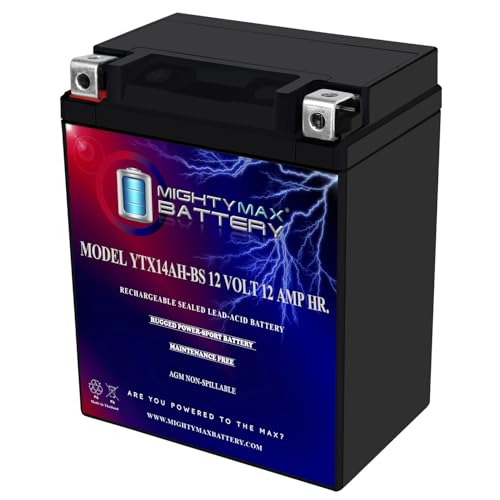
The Mighty Max YTX14AH-BS is the tall-case pick: a 12V, 12Ah sealed AGM battery with 210 cold cranking amps, measuring 5.20 by 3.50 by 6.40 inches, with positive on the left, negative on the right, bolt terminals, and a 1-year warranty. The listing states a spill-proof AGM build, a high discharge rate, a wide working temperature range, and long service life with deep discharge recovery, and the battery can mount in any position.
The watt math sits in the middle of the guide. At 12 amp-hours the stored energy works out to about 144 watt-hours. At 210 cold cranking amps the cranking power works out to about 2,520 watts. The listing publishes no weight figure, so this guide gives none. The height is the fact that matters most: at 6.40 inches this case is taller than the 5.71-inch YTX14-BS case, so it fits only bikes whose tray and seat clearance accept the taller YTX14AH-BS size. Do not buy this one for a YTX14-BS tray without measuring first. Buy this one if your bike manual names the YTX14AH-BS size, you want 2,520 cranking watts in a sealed AGM battery, and your tray has the height for it.
The UPLUS YTX14-BS is a 12V, 12Ah sealed AGM motorcycle battery measuring 5.91 by 3.43 by 5.71 inches and weighing 9.5 lb, with a 15-month warranty, the longest warranty in this guide. The listing names a long fitment list covering Honda, Suzuki, Kawasaki, and Yamaha machines, plus ATVs, scooters, snowmobiles, and UTVs, and it states a polypropylene case with better heat resistance than a standard ABS case.
The watt math is half complete, and this guide says so. At 12 amp-hours the stored energy works out to about 144 watt-hours. The listing publishes no cold cranking amp figure, so this guide gives no cranking-watt figure for this pick rather than borrowing a number from another source. Buy this one if your bike takes a YTX14-BS, you want the longest warranty in this guide, and stored energy matters more to you than a published cranking figure.
Comparison Table
Battery
Size code
Capacity
Watt-hours
Cranking amps
Cranking watts
Weight
Weize YTX12-BS
YTX12-BS
10Ah (bullets) / 12Ah (table)
About 120–144 Wh
200 CCA (table)
About 2,400 W
7.92 lb (bullets)
Yuasa YTX14-BS
YTX14-BS
12–12.6Ah
About 144–151 Wh
200 CCA
About 2,400 W
10.1 lb
ExpertPower YTX14-BS
YTX14-BS
14Ah
About 168 Wh
220 CCA
About 2,640 W
About 10.32 lb
Mighty Max YTX14AH-BS
YTX14AH-BS
12Ah
About 144 Wh
210 CCA
About 2,520 W
Not published
UPLUS YTX14-BS
YTX14-BS
12Ah
About 144 Wh
Not published
Not published
9.5 lb
Note: the Weize figures follow the listing bullets for capacity and weight, while the cranking-amp figure comes from the listing detail table, which also gives 12 amp-hours and a taller height. The Yuasa capacity reads 12.6 amp-hours in the bullets and 12 amp-hours in the detail table.
Which One Fits Your Situation
For a bike that takes a YTX12-BS, the Weize YTX12-BS is the direct match, and its 120 watt-hours on the bullet figures suit most middleweight machines, but measure the tray height first because the listing gives two different heights. For a bike that takes a YTX14-BS, choose between the Yuasa original-equipment battery, which needs filling and charging, the ExpertPower, which arrives charged with the most watt-hours and the most cranking watts in the guide, and the UPLUS, which carries the longest warranty but publishes no cranking-amp figure. For a bike that takes the taller YTX14AH-BS size, the Mighty Max is the match, and only that size: measure the tray height before you buy. If your bike will not turn over on a cold morning, cranking watts matter more than watt-hours, so pick by the cranking-amp column. If your bike sits for weeks between rides, watt-hours matter more, so pick by the amp-hour column.
FAQ
How many watts does a motorcycle battery have?
A typical 12V motorcycle battery holds about 120 to 170 watt-hours of stored energy and can deliver about 2,400 to 2,640 watts in a short cranking burst. A small scooter battery sits lower, near 100 watt-hours and under 1,500 cranking watts. The two numbers answer different questions: watt-hours decide how long the battery can run a load, and cranking watts decide how hard it can turn the engine over.
What is the difference between watts and watt-hours?
Watts measure power at one moment, and watt-hours measure energy over time. A battery that delivers 2,400 watts while cranking and a battery that stores 144 watt-hours are describing two different things. Multiply volts by amp-hours to get watt-hours. Multiply volts by cold cranking amps to get cranking watts. A battery can hold plenty of watt-hours and still fail to crank an engine if its cranking-amp figure is low.
How many watts does it take to start a motorcycle?
Most motorcycles need roughly 1,500 to 2,500 cranking watts to turn the engine over, depending on engine size, compression, and temperature. A cold engine needs more than a warm one, and a large V-twin needs more than a small single. The picks in this guide deliver 2,400 to 2,640 cranking watts where the listing publishes a cranking-amp figure, which covers most middleweight and large bikes.
Does a bigger battery give more watts?
A bigger battery in the same size code usually gives more watt-hours, because it holds more amp-hours, but cranking watts depend on the cranking-amp figure, not on size alone. The ExpertPower pick in this guide shows the pattern: 14 amp-hours gives it the most watt-hours, and 220 cold cranking amps gives it the most cranking watts. Check both figures on the listing rather than judging by case size.
Why does my battery read 12 volts but not turn the engine?
Voltage at rest tells you the state of charge, not the cranking power. A battery can read 12.6 volts at rest and still fail to deliver enough current under load, because its internal resistance has risen with age or sulfation. That is why listings publish cold cranking amps alongside volts: the cranking-amp figure, multiplied by 12 volts, is the better guide to whether the battery will turn the engine over.
Final Take
A motorcycle battery does not have one watt number. It has two: watt-hours for stored energy and cranking watts for starting power. For the common 12V AGM sizes in this guide, the answers are about 120 to 168 watt-hours and about 2,400 to 2,640 cranking watts. Work out both figures from any listing with the two formulas in this guide, match the size code to your bike first, and pick by the figure that matches your problem: cranking watts for hard cold mornings, watt-hours for long sits between rides. The ExpertPower YTX14-BS leads both columns in this guide, the Yuasa YTX14-BS is the original-equipment choice for riders who do not mind the fill-and-charge step, and the Weize YTX12-BS is the match for the smaller YTX12-BS tray, with its listing conflicts noted above.
B
Beckykinkead Editorial Team
We compare specs, materials and verified owner reviews before a product earns a spot. Rankings are never paid.
Affiliate disclosure. As an Amazon Associate we earn from qualifying purchases at no extra cost to you. Prices accurate as of the date shown.
How much is a Prius hybrid battery? It turns on generation, new or reconditioned modules, pack or module set, core exchange, and warranty. See 5 Prius packs.
Can Prius be driven long term without hybrid battery? The short answer, what fails first, and five verified live Prius hybrid battery modules and sets.
Find the best portable solar chargers for RVs, from foldable 100W panels to 220W bifacial kits, with wattage, controller and compatibility guidance today.
Find the best cock extenders in this clinical guide to traction devices, adjustable rods, comfort, fit, materials, safety, and what to check before buying.
Compare the best beauty cameras for flattering selfies and tutorials, from the Sony ZV-1 to the Canon G7 X Mark III and the Fujifilm Instax Mini Evo pick.
Compare non-electric greenhouse heaters that run on propane, with BTU output, coverage, ignition and safety shutoffs explained for off-grid growing spaces.
Compare gaming mice with extra programmable keys and thumb buttons, from a 20-button MMO mouse to an 11-button all-rounder, with sensors and layouts explained.
Looking for the best dual boiler espresso machines for couples? Compare four machines built for two-drink mornings, steam-while-brewing speed and routines.
Compare the best compact swim spas for outdoor renovation planning, from 12-foot trainers to 13-foot family models, and plan your pad, power, and access.

 2. Yuasa YTX14-BS Battery with Acid Pack
 3. ExpertPower YTX14-BS AGM SLA Motorcycle Battery
 4. Mighty Max YTX14AH-BS SLA AGM Motorcycle Battery
 5. UPLUS YTX14-BS Motorcycle Battery