Key takeaways
- Compare the best hockey goals for backyards and practice shots, from full-size steel nets to pop-up sets, and pick the right goal for your space.
A backyard hockey goal turns a driveway or a patch of lawn into a practice spot. Instead of aiming at a garage door, players get a real target and corners worth aiming for. The hard part is matching the goal to the space and the players: a regulation steel net suits a teenager working on wrist shots but can swallow a small yard, while a light pop-up set suits young kids yet slides when older players shoot hard.
As an Amazon Associate, we earn from qualifying purchases.
Quick Answer
For most backyards, the Franklin NHL Goal, Ball, and Stick Set at 54 inches is the easiest pick because it includes the goal, two sticks, and a ball in one box. Players who already own gear should look at the Franklin steel net on its own, while serious shooters with room to spare should step up to the regulation-size EZGoal 67109 Monster. Tight spaces call for the pop-up GoSports set.
How Big Should a Backyard Hockey Goal Be
A 54-inch-wide goal is the sweet spot for youth street hockey: wide enough to make scoring feel real, narrow enough to fit a driveway, and light enough for one adult to move. Two of the picks below use this width, and both suit players from about six years old through early teens.
A regulation goal measures 6 feet wide by 4 feet high, the same opening used in organized ice hockey. Shooters learn to pick corners at full size and goalies learn to cover a real net, but it needs more room behind the net and a clear shooting lane in front. In a narrow yard, a regulation frame may crowd everything else out.
Pop-up goals sit at the other end of the scale: the GoSports set opens to 48 inches wide and 36 inches high, a training and play goal rather than a permanent fixture. It shines when you want to set up in a minute and pack away just as fast. Smooth concrete or asphalt gives the truest bounce, while grass slows the ball and suits younger players, so leave a clear zone behind the goal for missed shots.
The 5 Goals Worth Your Backyard
1. Franklin NHL Goal, Ball, and Stick Set — 54 Inch
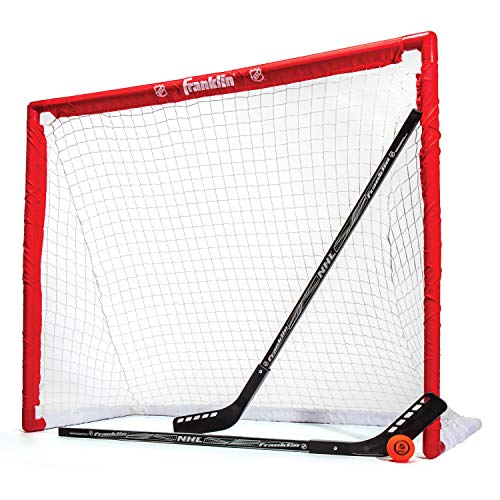
The Franklin set is the only pick here that arrives as a complete game in one box, and that is why it leads this list: a 54-inch steel-tube goal, two street hockey sticks, and a ball, so a family can play a game without a separate trip for gear. The goal carries NHL team colors, and the frame is sturdy enough for backyard games.
The 54-inch width hits the youth sweet spot: wide enough for real shooting practice, narrow enough to sit on a driveway without blocking the whole space. The steel frame holds its shape when balls hit the posts, and the deep net catches shots. The included sticks are sized for youth games, so taller teens will want longer sticks, and the net is built for street hockey balls rather than heavy pucks.
Specs
- Frame: Steel tube, 54 inches wide
- Includes: Goal, 2 street hockey sticks, 1 ball
- Net: Full-depth net that catches street hockey balls
- Best for: Families buying a first goal and kids learning the game
2. Franklin Youth Street Hockey Net — 54 Inch Steel

This is the goal-only sibling of the set above: plenty of households already own sticks and balls, so buying the net on its own means you pay for the part you actually need and keep the gear your players already like. The frame is steel, the width is the same 54 inches, and the net is built to the same youth scale.
Steel holds its shape through repeated shots on the posts and does not flex the way a plastic frame can. The net depth is generous for a youth goal: a shallow net spits balls back onto the driveway, while a deeper net swallows them and keeps the game moving. No sticks or ball come in the box, so a household with no gear should buy the complete set above instead.
Specs
- Frame: Steel, 54 inches wide
- Includes: Goal and net only, no sticks or ball
- Net: Youth street hockey net with full depth
- Best for: Players who already own sticks and balls
3. Mylec PVC Junior Folding Goal — 54 x 44 Inches

The Mylec goal is the lightest full-size youth net in this roundup, and that lightness changes how often it gets used. A PVC pipe frame weighs far less than steel, so one person can carry it from the garage to the driveway, set it up, and fold it flat for storage when the game ends. At 54 inches wide by 44 inches high, it is a touch taller than the Franklin nets, which gives shooters more top-shelf room.
Folding defines this goal: the frame breaks down quickly, the net stays attached, and the whole thing leans against a garage wall. PVC has limits, though: the frame flexes more than steel under a hard slap shot, so this goal suits wrist shots, younger players, and casual games better than teenagers winding up for full-power shots, and the clip-on net needs a check now and then.
Specs
- Frame: PVC pipe, folding design, 54 x 44 inches
- Includes: Goal and net, folds flat for storage
- Net: Youth net attached with clips
- Best for: Younger players, small yards, and easy storage
4. EZGoal 67109 Monster — 6 x 4 Feet Regulation
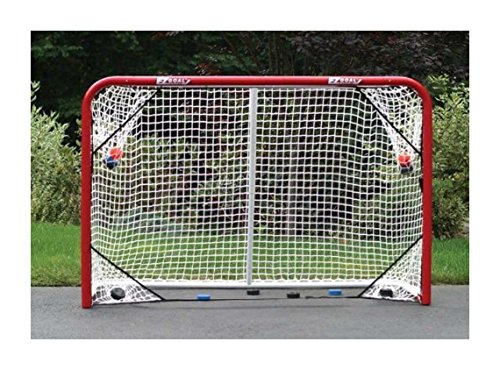
The EZGoal 67109 Monster is the only regulation-size goal in this roundup. The frame uses 2-inch steel tubing, the opening measures a full 6 feet wide by 4 feet high, and the net is a heavy 5 mm UV-protected mesh that stands up to sun, rain, and repeated hard shots. A pro top shelf runs across the upper frame, and four net target pockets hang in the corners so shooters can aim at something specific.
The folding system makes a goal this size practical at home: the frame folds flat with a quick pull of two pins, so it stores against a wall at only a few inches deep instead of standing in the yard all week. This is also the heaviest pick here by a clear margin, and it needs a firm, flat surface and a bit of muscle to move, so it is overkill for young kids and small yards. For teenagers and adults who practice several times a week, it grows with them instead of being outgrown in a single season.
Specs
- Frame: 2-inch steel tube, regulation 6 x 4 feet, folds flat
- Includes: Goal and net only, backstop sold separately
- Net: 5 mm UV-protected mesh with pro top shelf and 4 corner target pockets
- Best for: Serious practice and older players with room to spare
5. GoSports Hockey Street Set — Pop-Up Goal With Sticks and Balls

The GoSports set is the fastest route from box to game in this roundup. The goal pops open in seconds, the two sticks and two balls are already in the box, and the whole set packs down small enough to carry to a park. At 48 inches wide by 36 inches high, it fits younger children and games in tight spaces.
Pop-up goals win on convenience and lose on heft, and that trade is the whole story here. The light frame is easy for a child to carry and quick for a parent to set up, but it can shift when a hard shot hits the net, so it works best on flat ground and with players who are still learning to shoot. The included sticks are sized for kids, and the two balls mean a lost ball does not end the game. Think of it as a companion to a bigger goal: young kids can use it now and move up to steel later, while older players can keep it as a travel set.
Specs
- Frame: Pop-up design, 48 x 36 inches, sets up in seconds
- Includes: Pop-up goal, 2 sticks, 2 balls
- Net: Lightweight fabric net for casual play
- Best for: Young kids, travel, and small spaces
How to Choose
Frame material is the first decision, and it tracks closely with shot power. Steel frames hold their shape under hard shots and last across seasons, which is why three of the five picks use steel. PVC is lighter and easier to move, but it flexes when older players shoot hard, and pop-up fabric frames are lighter still and built for convenience, not for absorbing slap shots.
Size comes next, and it is really a question about your space. Measure the shooting lane before you buy: a 54-inch goal needs a driveway or lawn strip wide enough for the goal plus room for a shooter to stand several feet back, while a regulation 6-by-4 goal needs that and more. A goal that fits the yard gets used.
Goal-only versus complete set is a simpler call. If your household owns no sticks or balls, buy a complete set and skip the guesswork. If gear is already in the garage, a goal-only net gives you a better frame for the same spend. Net depth matters too: a deeper net catches shots and keeps play moving, while a shallow net sends balls bouncing back, and a backstop protects whatever sits behind the goal.
Who Should Skip
Skip the regulation EZGoal if your yard is small, since a 6-foot frame in a tight space turns practice into a chore. Skip the pop-up GoSports set if your players take hard slap shots, because a light frame will shift and tip when the net takes a direct hit. Skip the PVC Mylec goal if your household includes teenagers who shoot at full power, since the frame will flex and the clips will need frequent attention. Skip any goal-only pick if you own no sticks or balls. And skip mini and knee hockey goals for backyard play: they are indoor toys for kneeling games, far too small for a driveway game.
FAQ
What size hockey goal should I buy for a backyard?
A 54-inch-wide goal suits most backyards and youth players, because it fits a driveway, leaves room for a shooting lane, and handles real street hockey balls. Step up to regulation 6-by-4 only with the space and players old enough to use it. A pop-up goal near 48 inches wide works for young kids.
Can I use a street hockey goal on a driveway?
Yes, a driveway is a great surface for a street hockey goal, because smooth concrete or asphalt gives a true bounce and keeps the frame planted. Grass works too, though the ball moves slower and a heavy steel frame can settle into soft ground after rain. Leave a clear zone behind the goal so missed shots do not reach a fence or a car.
Do I need a backstop behind my hockey goal?
A backstop is worth adding when the goal faces a garage door, a fence, or anything breakable, because even careful shooters miss. The EZGoal accepts a backstop as an add-on, while the smaller youth goals sit close enough to a wall or fence that a simple barrier behind them does the job. With open lawn behind the goal, you can skip it.
How do I keep a hockey goal from moving during practice?
Heavy steel goals mostly stay put on their own, especially on flat concrete, while light goals need help. Set the goal on level ground, check that all four feet touch the surface, and weigh down a pop-up frame with sandbags when shots get hard. Moving the shooting lane closer also cuts the force each shot carries into the net.
Final Verdict
For most households, the Franklin NHL Goal, Ball, and Stick Set is the pick to make, because it covers the whole game in one box at the youth size that fits nearly any backyard. Players who already own gear should take the Franklin steel net on its own. The Mylec folding goal is the right call when storage space is tight and the players are young, while the GoSports pop-up set suits small children, travel, and quick games. When practice gets serious and the yard allows it, the EZGoal 67109 Monster is the regulation goal that will still be standing as the players grow into it.
Product and ASIN Reference
| Product | ASIN |
| Franklin NHL Goal, Ball, and Stick Set 54 Inch | B00QU93OBC |
| Franklin Youth Street Hockey Net 54 Inch Steel | B00V57L880 |
| Mylec PVC Junior Folding Goal 54 x 44 Inches | B00004YTMV |
| EZGoal 67109 Monster Hockey Goal 6 x 4 Feet | B00LW5YCII |
| GoSports Hockey Street Set Pop-Up Goal | B08D2XCQ5S |