We independently review everything we recommend. When you buy through our links, we may earn a commission. As an Amazon Associate we earn from qualifying purchases.
4 Best Ground Blinds for Crossbow Hunting (November 2026)
Four ground blinds sized for crossbows, compared on shooting width, footprint, window layout and carry weight, for partner hunts and solo sits alike.
Four ground blinds sized for crossbows, compared on shooting width, footprint, window layout and carry weight, for partner hunts and solo sits alike.
A crossbow changes what a ground blind has to do. The limbs sweep wide the moment the string releases, the bow sits horizontal instead of vertical, and most shots are taken seated with the fore-end resting steady. A blind that works for a vertical bow can still fail here: a limb tip clips a wall, the window sill sits too high for a seated shot, or the door forces you to drag the bow in sideways and bump every piece of gear you own.
This roundup is for crossbow hunters who sit field edges and food plots, for pairs who share one blind, and for mobile hunters who move spots during the season. Every blind below was chosen from the measurements on its own Amazon listing: footprint, hub-to-hub width, shooting width, window layout and the frame and fabric the maker states.
Quick Picks
As an Amazon Associate we earn from qualifying purchases.
Product
Best for
Key spec from title
Barronett Big Cat 350
Two hunters and standing shots
90-inch hub-to-hub width, 80-inch height
TIDEWE 360 See Through
Watching every approach lane
360-degree one-way see-through walls
Ameristep Care Taker Kick Out
Width on a compact footprint
69-inch shooting width, 55-inch footprint
Ameristep Caretaker Run & Gun
Moving between spots on foot
12 lb carry weight, 63-inch shooting width
How to Choose
Start With Shooting Width, Not Floor Size
A crossbow is widest exactly where a blind is narrowest: at seated height, near the walls. Floor dimensions alone hide this, because hub-style walls bow outward and the usable width at limb height is the hub-to-hub or shooting width figure. Compare that number against your bow’s axle-to-axle width at full draw, then add room for the stirrup to rest forward and for you to shift in the chair. A blind that lists a dedicated shooting width, like the two Ameristep models below, is easier to judge than one that only prints a footprint.
Match Window Height to a Seated Shot
Crossbow shots from a blind are almost always taken sitting down, with the bow held level or tipped slightly down toward a feeding lane. Windows cut for standing archers sit too high, forcing you to raise the bow and silhouette your movement against the opening. Look for low, wide horizontal windows or sliding panels you can set at chair height, and check whether the mesh is replaceable shoot-through material. Trapezoid windows that widen at the bottom suit a rested crossbow better than tall narrow ports.
Decide How Much View You Actually Need
Solid fabric walls with a few windows hide movement best but leave you blind to animals approaching from the side or behind. One-way see-through panels, like the TIDEWE walls below, let you watch a full circle of woods without opening anything, which matters when deer drift in quietly. The trade is discipline: see-through fabric works when the interior stays dark and you sit still. If your spot faces open sky or low sun, blackout curtains and fewer openings may serve you better than panoramic mesh.
Weigh the Carry Against the Season
A blind you set once in September and leave until January can be heavy, wide and tall. A blind you carry into public land twice a week cannot. Packed weight, bag style and hub design decide which kind you are buying. Five-hub frames with fiberglass poles fold into a backpack-style bag and go up fast, but every extra foot of width adds pounds. Match the blind to the walk: drive-up private land forgives the big Barronett, while a mile of trail argues for the lightest Ameristep.
The Big Cat is the room-first answer for crossbow hunters who share a blind or shoot beside a tripod rest. Ninety inches hub to hub means the walls bow well away from a drawn bow’s limbs, and the 80-inch center height lets a tall hunter stand, stretch and even take a standing shot during a long sit. Six trapezoid windows and two peek windows ring the blind, with replaceable shoot-through mesh and separate ports for firearm season. For a mentor hunting with a young shooter, or two adults with packs and chairs, this is the blind that never feels crowded.
The TIDEWE takes the opposite approach to concealment: instead of a few windows in solid walls, all four walls use one-way perforated fabric, so you can watch deer approach from any direction without opening a panel or turning in your chair. Ten windows, one rectangular and nine trapezoidal, ride on dual silent sliding rails, so the opening you shoot through can be set at seated crossbow height and adjusted without a sound. The swing door opens a full 90 degrees on buckles and straps, which makes getting a wide bow and a chair inside far less awkward than a small zippered flap.
The Kick Out solves the crossbow width problem from the floor up. Its base corners flare outward, pushing the walls away from your feet and giving the bow’s limbs clearance low in the blind, where a standard square footprint pinches hardest. Ameristep lists a 69-inch shooting width on a 55-inch footprint, so a seated hunter can swing on a crossing target without the stirrup or limb tips finding fabric. Nine shoot-through mesh windows cover the sides, and the ShadowGuard interior coating keeps your outline from printing through the shell when the sun is behind you.
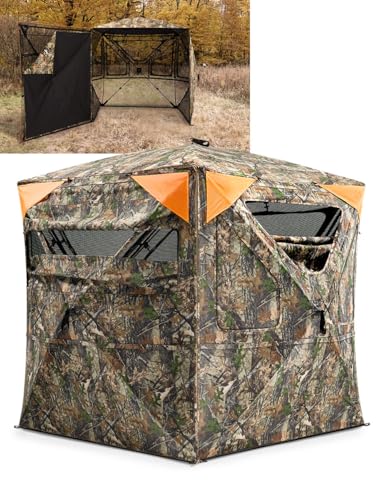
The Run & Gun is the downsized Caretaker, built for hunters who treat a blind as something they carry rather than something they park. At 12 pounds with a footprint under 50 inches square, it goes on your back for the walk in and pops up on the Spider Hub frame when a fresh scrape or a new crossing changes your plan. The 63-inch shooting width still clears a crossbow’s limbs at seated height, and the tension relief zipper system is there to make takedown easier when the fabric is cold and stiff at the end of a sit.
Which One Fits Your Situation
You Hunt With a Partner or a Young Shooter
Two chairs, two packs and one crossbow need width more than anything else. The Barronett Big Cat 350 gives you a 90-inch hub-to-hub span and standing height, so the second person can shift, range and coach without bumping the bow. Set it up early, brush it in well, and leave it for the season.
Game Approaches From Several Directions
On a plot corner or a trail crossing, animals rarely use the lane you planned for. The TIDEWE 360’s see-through walls let you track movement all the way around while seated, and its sliding windows open quietly at the height your crossbow already rests. Keep the blackout curtain on the brightest side.
You Hunt Alone From Tight Cover
When the only good spot is a small gap in thick brush, the Ameristep Care Taker Kick Out fits where wide blinds will not, and its flared base still gives your limbs a 69-inch shooting width. It is the compact blind that does not ask you to cant the bow or hug the back wall.
You Walk In and Move Often
If your hunts start with a long walk and your spot changes with the sign, the Caretaker Run & Gun at 12 pounds is the one that actually comes along. The smaller footprint sets up in tight places between trees, and the lighter carry leaves energy for the drag out afterward.
Common Mistakes
Judging a blind by footprint alone and never checking the shooting width against the crossbow’s axle-to-axle span at full draw.
Setting windows at standing height, then having to lift the bow into view and silhouette every movement at the moment of the shot.
Skipping the stakes and tie-downs on a calm morning, then losing the blind to the first afternoon wind that catches those wide walls.
Leaving a see-through blind’s interior bright, with light clothing and open curtains on every side, which defeats the one-way fabric.
Placing the blind so close to the lane that the limbs clear the wall but the arrow’s path crosses the window frame on quartering shots.
Frequently Asked Questions
How wide does a ground blind need to be for a crossbow?
Start from your bow’s axle-to-axle width at full draw and add room to shift in the chair and rest the stirrup forward. In practice that points to a listed shooting width in the mid-60-inch range or better, which is why the Ameristep models print that figure and why hub-to-hub width matters more than floor size alone.
Can you shoot a crossbow through blind mesh windows?
Only through mesh the maker lists as shoot-through, and the blinds above use replaceable shoot-through mesh for that purpose. Fixed-blade heads are the safer match for mesh; mechanical heads can open early on contact. Many hunters simply open the window panel for the shot and keep mesh for viewing, which removes the question entirely.
Is a see-through blind better than a standard fabric blind?
It solves a different problem. See-through walls give you a full circle of view without moving or opening windows, which helps on crossings and plot corners. Standard walls hide sloppy movement better and stay darker inside. Choose by your spot: multiple approach lanes favor see-through fabric, while a single known lane favors solid walls and discipline.
How far ahead should a blind be set up before hunting?
Earlier is better, because deer notice a new object in their woods. A week or more lets the blind become part of the scenery, especially if you brush it in with local limbs and leaves. When that is not possible, a pop-up hub blind set the same day still works if you brush it heavily and hunt the wind carefully.
B
Beckykinkead Editorial Team
We compare specs, materials and verified owner reviews before a product earns a spot. Rankings are never paid.
Affiliate disclosure. As an Amazon Associate we earn from qualifying purchases at no extra cost to you. Prices accurate as of the date shown.
Four rear-deploying mechanical broadheads compared on cutting diameter, blade retention and ferrule build, with the specs that matter for compound bows.
Best Foaming Wheel Cleaner 2: five foaming wheel cleaners compared by foam cling, color-change action, finish safety, and size to help you pick the right one.
Best 3 leaf trailer springs roundup: five 3-leaf springs from Trailer Supplies, Dorman, Sturdy Built and FWN, compared by length, capacity and end style.
The best veggies for kabobs on the grill, grouped by cooking time, with cut sizes, marinade basics and skewer layouts that keep every piece evenly done.
Best oil for F150 3 5 EcoBoost: five 5W-30 oils verified live on Amazon US, with spec notes, label checks and the 6-quart fill for the 3.5L twin-turbo.
Best drilled and slotted rotors 2: five front and rear brake kits verified live on Amazon US, with fitment, rotor sizes, pad compounds and warranty notes.
Best ATV chain lube 2: five chain lubes and waxes verified live on Amazon US, with O-ring fit, wet and dry coverage, and fling notes for sealed chains.
Best 5 inch exhaust heat shield: five shields compared — 5-inch round stainless shields, universal Walker and Patriot chrome shields, and an adhesive heat mat.



 Ameristep Caretaker Run & Gun